
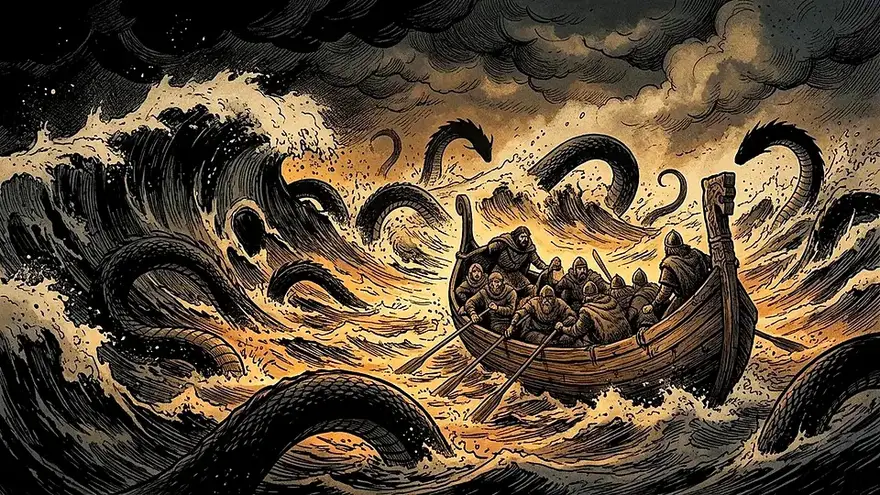
The Hebrew text of Jonah 1:17 simply says YHWH appointed a dag gadol (דָּג גָּדוֹל, 'great fish'). 'Whale' entered English pop culture because the Greek Septuagint and Matthew 12:40 translated dag gadol as kētos ('giant sea creature'), which the 1611 King James Bible rendered 'whale' over a century before modern biology separated whales from fish.
Two plain Hebrew words in Jonah 1:17: 'Dag Gadol'
Open the Hebrew Book of Jonah (where English 1:17 is numbered 2:1) and look for whales, sharks, or sea dragons. Instead of exotic mythology like Job's fire-breathing Leviathan (livyatan) or Genesis 1's great sea monsters (tanninim), Jonah uses the two plainest words in Hebrew: dag gadol—'a great fish.'
Notice the verb right in front of it: wayeman YHWH dag gadol ('And the LORD appointed a great fish'). That verb manah ('appoint / assign') repeats four times across forty-eight verses—God appoints the fish (1:17), the shade plant (4:6), the tiny worm (4:7), and the scorching east wind (4:8). Every creature obeys instantly except God's own prophet!
Jonah 1:17“And the LORD appointed a great fish (dag gadol) to swallow up Jonah. And Jonah was in the belly of the fish three days and three nights.”
Why It Matters: Matthew 12:40 simply quoted the 3rd-century BCE Greek Septuagint of Jonah (kētos = any giant sea creature: whale, shark, or sea-monster), which 1611 translators rendered 'whale' 147 years before taxonomy separated mammals from fish.
Scrolls & Archaeology: Curiously, Hebrew Jonah shifts grammatical gender mid-chapter: verse 1:17 introduces masculine dag gadol ('a great fish'), verse 2:1 switches abruptly to feminine ha-dagah ('the female/collective fish') as Jonah begins praying, and verse 2:10 reverts to masculine la-dag when vomiting him ashore. Swedish naturalist Carl Linnaeus first removed whales from the class Pisces ('fishes') into Mammalia in the tenth edition of Systema Naturae in 1758.
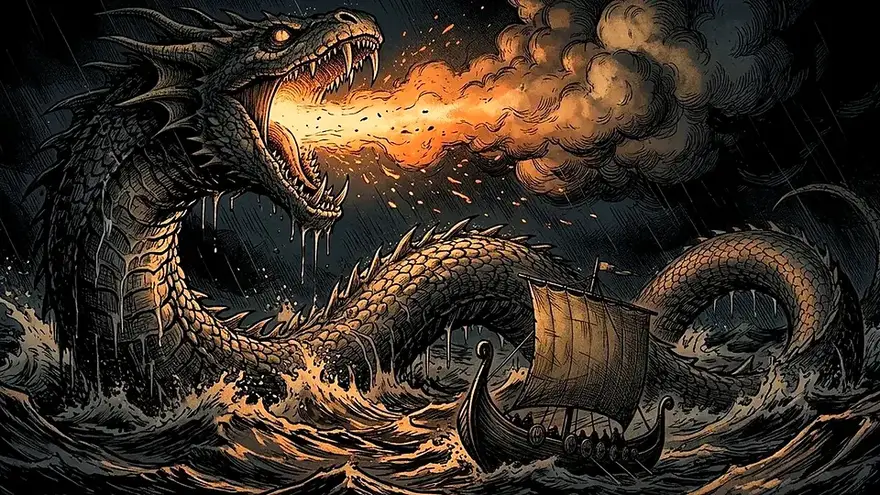
How Greek 'kētos' and the 1611 King James Bible turned the fish into a whale
When Jewish translators in Alexandria rendered Jonah into Greek around the 3rd century BCE, they translated dag gadol as kētos mega—a flexible Greek term covering any colossal deep-sea creature, from whales and giant sharks to mythic sea monsters. Four centuries later, Matthew 12:40 quoted the Septuagint word-for-word: 'in the belly of the kētos.'
Then came 1611. Over 140 years before Swedish botanist Carl Linnaeus classified whales as warm-blooded mammals in 1758, Tudor English classified every giant swimmer as a fish (Herman Melville was still calling sperm whales 'fish' in Moby-Dick in 1851!). The KJV wrote 'great fish' in Jonah 1:17 and 'whale' in Matthew 12:40—and Sunday schools never looked back.
Matthew 12:40 (KJV vs. ESV)“KJV: 'Three days and three nights in the whale's belly' · ESV: 'Three days and three nights in the belly of the great fish (kētous).'”
The bizarre Hebrew gender flip from 'dag' (he-fish) to 'dagah' (she-fish)
Read Jonah in Hebrew and a weird grammatical twist jumps off the scroll. In Jonah 1:17, the fish that swallows Jonah is masculine (dag); in the very next verse (2:1), Jonah prays from inside the belly of a feminine fish (ha-dagah)—and in 2:10, a masculine fish (dag) vomits him onto dry land!
Medieval rabbis like Rashi spun a delightful midrash out of that shift: Jonah sat too comfortably inside the roomy male fish, so God transferred him into a cramped pregnant female fish teeming with thousands of embryos until he finally prayed! Modern Hebrew scholars explain dagah either as a collective/poetic variant or a deliberate womb-metaphor cradling Jonah between death and new birth.
Jonah 2:1, 10“Then Jonah prayed to the LORD his God from the belly of the fish (ha-dagah, fem.)... And the LORD spoke to the fish (la-dag, masc.), and it vomited Jonah out upon the dry land.”
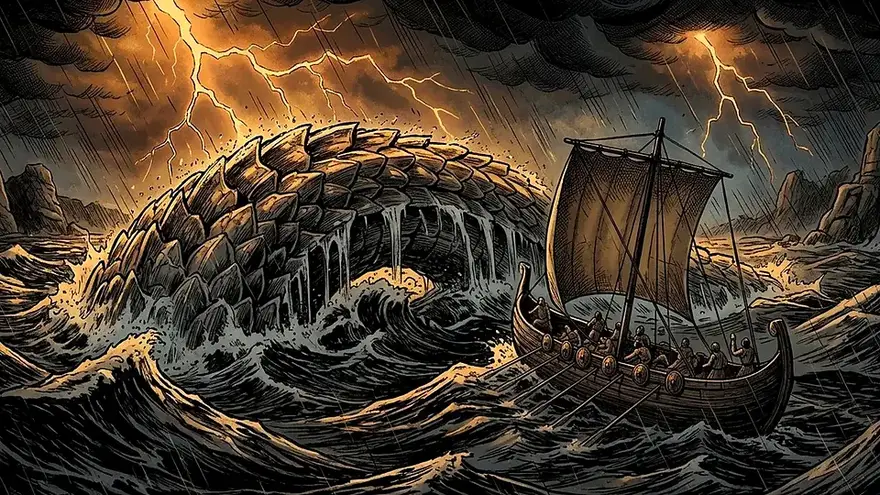
Plot twist: The fish wasn't Jonah's punishment—it was his lifeboat
Childhood picture books treat the fish like cosmic detention for running away to Tarshish. Read Jonah's psalm in chapter 2 and you realize the exact opposite happened: pagan sailors had already thrown Jonah into a raging Mediterranean gale, where currents dragged him to the roots of the mountains with seaweed wrapped around his skull.
Jonah was drowning at the barred gates of Sheol ('the Pit') when YHWH's appointed fish scooped him out of watery death! And the fish disappears by verse 2:10 because the real scandal of Jonah isn't how a man survived inside a fish—it's why a religious nationalist hated seeing God forgive his brutal Assyrian enemies in Nineveh.
Jonah 2:5–6“The waters closed in over me to take my life; the deep surrounded me; weeds were wrapped about my head at the roots of the mountains. I went down to the land whose bars closed upon me forever; yet you brought up my life from the pit.”
Tracking Jonah's Creature Across Four Languages & Eras
Watch how two ordinary Hebrew words grew into English culture's 'Jonah and the Whale' before modern Bibles restored 'great fish.'
| Text / Translation | Date | Original Term | Literal Meaning in Its Era |
|---|---|---|---|
| Hebrew Masoretic Text (Jonah 1:17; 2:1) | Iron Age / Post-exilic | Dag gadol (דָּג גָּדוֹל) / Dagah | 'Great fish' (generic aquatic creature; switches masc. to fem.) |
| Greek Septuagint & Matthew 12:40 | 3rd c. BCE – 1st c. CE | Kētos mega (κῆτος μέγα) | 'Huge sea creature' (whales, giant sharks, deep-sea monsters) |
| Latin Vulgate (Jerome) | ~400 CE | Piscis grandis (Jonah) / Cetus (Matt) | 'Large fish' in Jonah; Latinized Greek 'cetus' in Matthew |
| 1611 King James vs. Modern ESV/NIV | 1611 vs. 20th–21st c. | 'Whale' (KJV Matt 12:40) vs. 'Great fish' | Modern translations harmonize both testaments back to 'great fish' |
What to Remember
- Hebrew Jonah 1:17 names no marine species at all—only a dag gadol ('great fish'), appointed by the exact same verb God uses for Jonah's plant, worm, and wind.
- The 1611 KJV printed 'great fish' in Jonah 1:17 and 'whale' for Greek kētos in Matthew 12:40 at a time when English 'whale' and 'fish' covered any giant sea creature.
- In Jonah 2, the fish isn't God's punishment on a stubborn prophet—it is a sudden underwater rescue boat saving Jonah from drowning at the gates of Sheol.