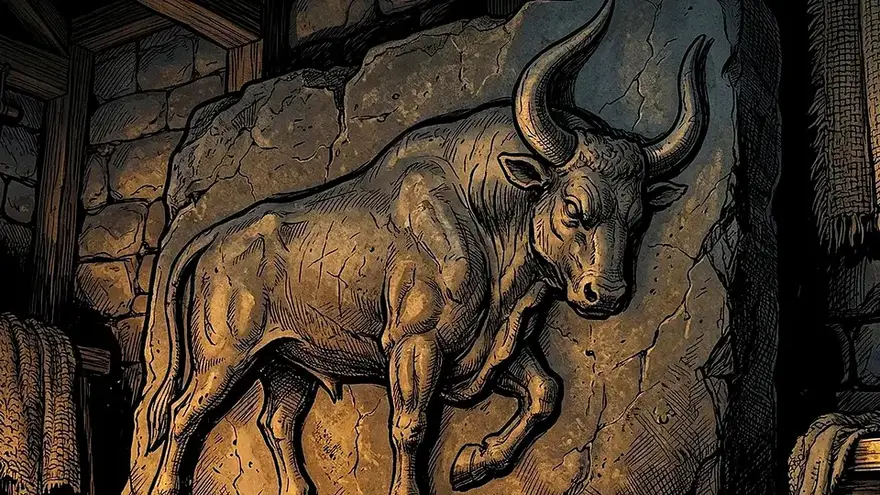
The 1611 King James translators were not inventing fairy tales; they inherited Greek and Latin zoological labels for real Middle Eastern wildlife. Hebrew re'em (רְאֵם, the massive two-horned extinct wild ox Bos primigenius, carved in single-horn profile on Babylon's Ishtar Gate) became Greek monokeros ('one-horn') and Latin unicornis—producing nine KJV 'unicorns.'
Nine KJV 'unicorns'—and Deuteronomy 33:17 proves it had TWO horns!
Internet skeptics love quoting Job 39:9 or Numbers 23:22 from the 1611 King James Version ('He hath as it were the strength of an unicorn') to dismiss Scripture as medieval folklore. Read those nine verses closely, though, and the Hebrew re'em (רְאֵם) looks nothing like a sparkly fairy-tale horse—it is an untamable brute farmers wish could pull a heavy plow (Job 39:10).
Better yet, Deuteronomy 33:17 proves its anatomy right inside the Hebrew grammar: Moses blesses Joseph with 'the horns [plural] of a re'em [singular]' (קַרְנֵי רְאֵם), symbolizing two tribes (Ephraim and Manasseh) on one beast! In 1611, KJV translators quietly pluralized singular re'em into 'horns of unicorns' so the math wouldn't break.
Deuteronomy 33:17 (Hebrew vs. 1611 KJV)“Hebrew literal — 'His horns are the horns of a wild ox [re'em—singular!]' · 1611 KJV — 'His horns are like the horns of unicorns.'”
Why It Matters: Deuteronomy 33:17 catches the Greek 'one-horn' translation red-handed: Hebrew assigns PLURAL 'horns' (qarnei) to ONE singular re'em, forcing the 1611 KJV translators to quietly pluralize 'unicorns' so a unicorn wouldn't sprout two horns!
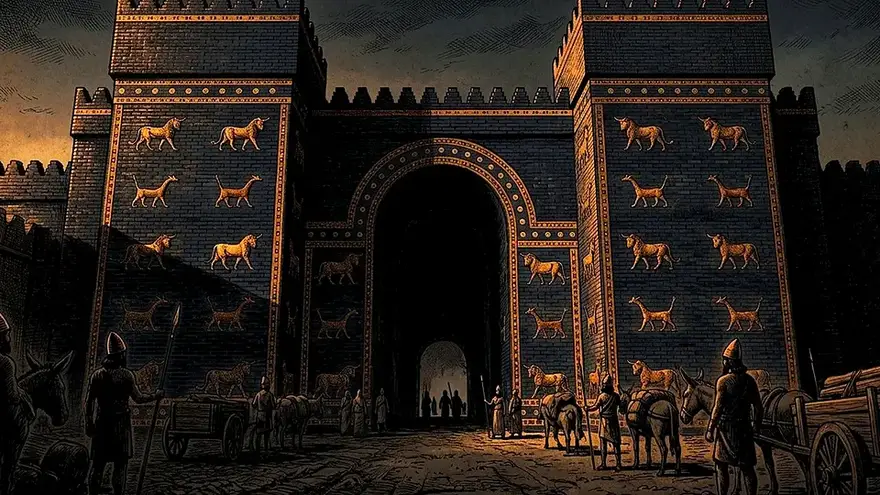
Scrolls & Archaeology: Assyrian royal hunting annals of Tiglath-Pileser I (c. 1100 BCE) boast of slaying fierce wild rīmu bulls (the giant six-foot-tall Eurasian aurochs, Bos primigenius) at the foot of Lebanon, and Neo-Babylonian glazed-brick reliefs on Nebuchadnezzar's Ishtar Gate depict them in strict side profile so their two sweeping horns overlap as one. Remarkably, the wild aurochs was not even extinct when the King James Bible went to press in 1611: the last recorded female died in Poland's Jaktorów Royal Forest in 1627.
Babylon's Ishtar Gate and the Greek monokeros -> Latin unicornis chain
How did a two-horned beast turn into 'unicorn'? Nineteenth-century decipherment of Akkadian cuneiform solved the mystery: Akkadian rīmu—exact cognate of Hebrew re'em—was the giant Eurasian wild ox or aurochs (Bos primigenius), standing six feet at the shoulder, hunted by Assyrian kings, and extinct across Mesopotamia before Hellenistic times.
Inspect the blue-glazed bulls on Babylon's Ishtar Gate (~575 BCE): artists carved the rīmu in strict side profile, making two horns overlap as one! Around 250 BCE, Alexandrian Jewish translators—knowing profile reliefs and travelers' tales of the Indian rhinoceros—rendered re'em as Greek monokeros ('one-horn'), becoming Latin unicornis and 1611 English 'unicorn' (then used for rhinos too!).
Job 39:9–10“Is the wild ox [re'em; KJV: unicorn] willing to serve you? Will he spend the night at your manger? Can you bind him in the furrow with ropes?”
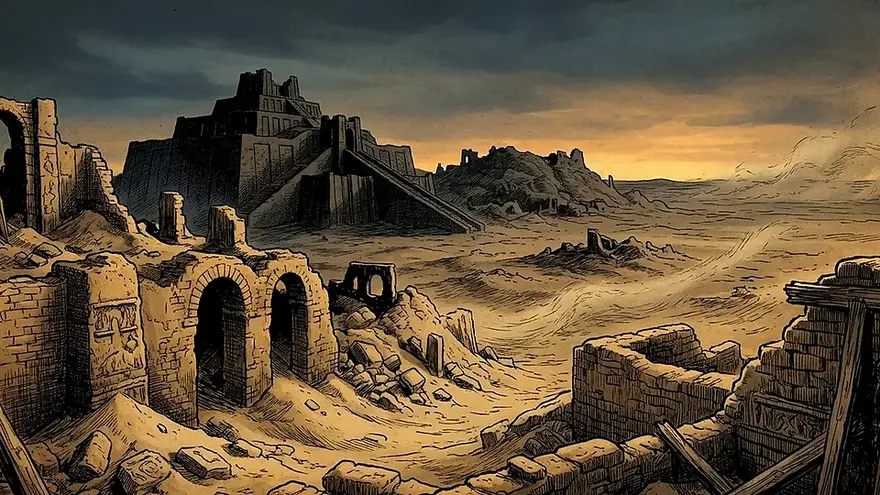
Why 'satyrs' dance in Babylon's ruins (Isaiah 13:21 & 34:14)
Turn to Isaiah 13:21 and 34:14 in the 1611 KJV and Greek half-goats hop across conquered empires: 'owls shall dwell there, and satyrs shall dance there.' Did Isaiah endorse pagan woodland mythology? The underlying Hebrew noun is se'irim (שְׂעִירִים)—literally 'shaggy / hairy ones,' the everyday Hebrew word for rough-coated male goats!
At the same time, Leviticus 17:7 and 2 Chronicles 11:15 show ancient desert dwellers superstitiously offered sacrifices to se'irim ('goat-demons' haunting desolate ruins). Picturing proud Babylon reduced to eerie rubble where hyenas, ostriches, and wild billy goats caper—carrying a spooky double resonance of wasteland spirits—Jerome wrote Latin pilosi ('hairy ones'), which classically schooled Tudor translators rendered 'satyrs.'
Isaiah 13:21 (1611 KJV vs. ESV)“1611 KJV — 'And owls shall dwell there, and satyrs [se'irim] shall dance there.' · ESV — 'Ostriches will dwell there, and wild goats will dance there.'”
'Cockatrices' and 'fiery flying serpents': Tudor bestiaries vs. desert vipers
Two final creatures startle KJV readers: the 'cockatrice' (a legendary rooster-serpent whose glare killed on sight, KJV Isaiah 11:8; 14:29; 59:5) and the 'fiery flying serpent' (saraph me'opheph, Isaiah 14:29; 30:6). In Hebrew, the 'cockatrice' is tzefa or tzif'oni (צִפְעוֹנִי)—an egg-laying venomous snake (modern Israeli Hebrew still calls the deadly Levant viper tzefa!). Because chilly Britain had only one native adder, 1611 scholars borrowed dramatic Tudor names from Latin regulus ('basilisk').
Meanwhile, Isaiah's Negev 'flying burning serpent' vividly captures desert vipers or cobras that coil and launch themselves explosively across sand dunes—delivering 'fiery' burning venom. Archaeological recovery of Akkadian and Near Eastern zoology allowed modern Bibles to restore every real animal.
Isaiah 11:8 (1611 KJV vs. ESV)“1611 KJV — 'And the weaned child shall put his hand on the cockatrice' den.' · ESV — 'And the weaned child shall put his hand on the adder's den.'”
1611 King James Mythical Bestiary → Original Hebrew Animals
Click any mythical creature in the 1611 KJV to uncover the real Iron Age Middle Eastern animal behind it.
Deuteronomy 33:17 explicitly speaks of 'the HORNS (plural!) of a re'em.' Greek translators in Egypt knew giant single-horned rhinos/profile reliefs as monokeros ('one-horn'), leading Latin unicornis and KJV 'unicorn.'
KJV translators merged desert tannim ('howling jackals' haunting ruins in Mic 1:8 & Mal 1:3) with aquatic tannin ('sea monsters / giant reptiles' in Gen 1:21 & Ps 74:13) under the single English word 'dragons.'
Hebrew sa'ir means both a shaggy he-goat and desert goat-spirits outlawed in Leviticus 17:7—which Greek and KJV translators rendered with classical 'satyrs.'
Medieval bestiaries claimed a 'cockatrice' hatched from a rooster's egg by a toad could kill with a glance; Hebrew tzefa simply denoted a lethal Levantine pit/viper.
Decoding Four Strange Creatures in the 1611 King James Bible
How ancient Near Eastern wildlife turned into Tudor bestiary creatures via Greek and Latin intermediaries.
| 1611 KJV Creature | Hebrew Term | Greek LXX / Latin Bridge | Actual Animal & Modern Rendering |
|---|---|---|---|
| Unicorn (9×: Num 23:22; Job 39:9) | re'em (רְאֵם) | monokeros -> unicornis ('one-horn') | Extinct giant two-horned wild ox / aurochs ('wild ox') |
| Satyr (2×: Isa 13:21; 34:14) | se'irim (שְׂעִירִים) | daimonia -> pilosi ('shaggy ones') | Shaggy desert billy goats / wasteland goat-spirits ('wild goats') |
| Cockatrice (4×: Isa 11:8; Jer 8:17) | tzif'oni (צִפְעוֹנִי) | aspis / basiliskos -> regulus | Deadly egg-laying Levant viper or adder ('viper' / 'adder') |
| Fiery Flying Serpent (2×: Isa 14:29; 30:6) | saraph me'opheph (שָׂרָף מְעוֹפֵף) | opheis petomenoi -> serpens volans | Darting/springing Negev desert viper with burning venom ('flying fiery serpent') |
What to Remember
- Deuteronomy 33:17 proves Hebrew re'em had two horns ('horns [plural] of a wild ox [singular]'), matching Akkadian rīmu—the extinct giant aurochs Bos primigenius.
- Side-profile bull reliefs (like Babylon's Ishtar Gate) plus rumors of the Indian rhinoceros led Greek Septuagint translators to render re'em as monokeros ('one-horn').
- KJV 'satyrs' translate se'irim ('shaggy wild goats / desert goat-spirits'), while 'cockatrices' translate venomous Palestinian vipers (tzif'oni).