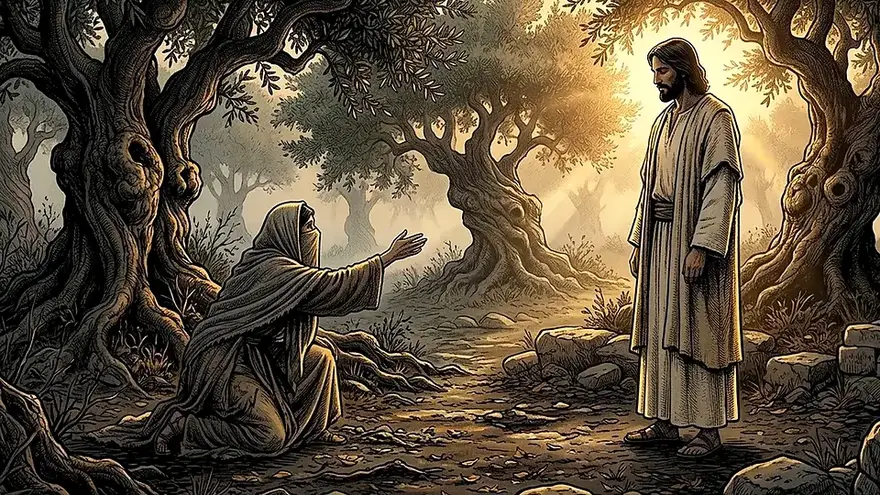
Zero verses in the New Testament call Mary Magdalene a prostitute. Luke 8:2–3 introduces her as a prominent disciple from the Galilean fishing port of Magdala whom Jesus healed of seven demons (daimonia hepta), and who helped fund His ministry from her own wealth (hyparchontōn). Her reputation as a 'repentant prostitute' began in 591 CE when Pope Gregory I merged three separate women.
Who Luke 8 and John 20 actually describe: wealthy patron and first resurrection witness
Nearly every woman in the Gospels is identified by a husband, father, or son ('Joanna, wife of Chuza,' 'Mary, mother of James'). Mary Magdalene is known solely by her hometown—Magdala (Aramaic Migdal, 'Tower'), a prosperous salted-fish harbor on the western shore of Galilee where archaeologists recently excavated a first-century synagogue and stone market.
Luke 8:2–3 reports that Jesus freed her from 'seven demons'—ancient Jewish shorthand for severe affliction, never prostitution—after which she helped underwrite His ministry 'out of their own means' (hyparchontōn). When male disciples scattered at Golgotha, Mary stayed by the cross and stood first before the risen Christ in John 20:16–18.
Luke 8:2–3“Mary, called Magdalene, from whom seven demons had gone out, and Joanna, the wife of Chuza, Herod's household manager, and Susanna, and many others, who provided for them out of their means.”
Why It Matters: Far from portraying Mary of Magdala as a street prostitute, Luke 8:2–3 lists her at the head of wealthy Galilean female patrons—right beside the wife of Herod Antipas's royal finance minister—underwriting Jesus's traveling disciples!
Scrolls & Archaeology: On September 14, 591 CE at Rome's Basilica of San Clemente, Pope Gregory I preached Homily 33 equating Luke 8:2's Mary Magdalene with Luke 7:37's unnamed 'sinful woman' and John 12's Mary of Bethany—a Western conflation the Eastern Orthodox Church never accepted and the Vatican formally dropped from its liturgical calendar in 1969. Excavations at Magdala (Migdal) since 2009 uncovered a prosperous 1st-century port lined with stone fish-salting vats exporting garum across the Roman Mediterranean, illuminating the economic hub behind Mary's title.
September 591 CE: How Pope Gregory I blended three separate women into one
How did history get her story so wrong? Immediately before Luke introduces Mary Magdalene as a brand-new character in Luke 8:2, Luke 7:37 describes an unnamed 'woman of the city, who was a sinner' washing Jesus's feet with tears and ointment. Six months later in Judea, Mary of Bethany (sister of Martha and Lazarus) anoints Jesus in John 12:3.
Delivering Homily 33 at Rome's Basilica of San Clemente in September 591 CE, Pope Gregory the Great declared all three women were identical, preaching that Mary's 'seven demons' meant every vice, starting with bodily lust. Western painters draped her in scarlet for fourteen centuries—while Greek and Eastern Orthodox churches rejected Gregory's merger from day one.
John 20:17–18“Jesus said to her... 'Go to my brothers and say to them, I am ascending to my Father and your Father.' Mary Magdalene went and announced to the disciples, 'I have seen the Lord.'”
The Vatican's quiet 1969 correction—and elevating her feast in 2016
Once modern scholars read each Gospel side by side in Greek, Gregory's three-in-one theory fell apart. Luke never hints that chapter 7's anonymous townswoman is chapter 8's newly introduced Mary of Magdala, and Mary of Bethany lives beside Jerusalem rather than a Galilean fishing town eighty miles north.
In 1969, Pope Paul VI revised the Roman Catholic liturgical calendar for July 22, dropping Luke 7's 'sinful woman' reading and removing the label 'penitent' from Mary Magdalene's mass. Then in June 2016, Pope Francis elevated her memorial to a full liturgical Feast equal to the apostles, foregrounding Hippolytus and Thomas Aquinas's title Apostola Apostolorum ('Apostle to the Apostles').
Mark 15:40–41“There were also women looking on from a distance, among whom were Mary Magdalene, and Mary the mother of James the younger and of Joses, and Salome. When he was in Galilee, they followed him and ministered to him.”
Was she married to Jesus? What the moth-eaten 'Gospel of Philip' actually says
Twenty-first-century thrillers like The Da Vinci Code swung from medieval slander to modern fiction, claiming early banned Gospels reveal Mary Magdalene was secretly Jesus's wife and mother of a royal bloodline. Yet no ancient text—canonical or Gnostic—ever calls her Jesus's spouse.
Inside the third-century Coptic Gospel of Philip (unearthed in Egypt in 1945), damage holes eat right through the famous line ('used to kiss her on her [...]'), and its word koinōnos ('companion') was a Greek loanword for a spiritual fellow-disciple rather than Coptic hime ('wife'). Ascetic Gnostic authors actually despised physical marriage and childbirth, portraying Mary instead as a visionary student who grasped heavenly mysteries.
1 Corinthians 9:5 (Early Witness on Apostolic Wives)“Do we not have the right to take along a believing wife, as do the other apostles and the brothers of the Lord and Cephas?”
The Three Distinct Gospel Women Merged by Pope Gregory I (591 CE)
Why Eastern Orthodoxy and modern biblical scholars keep these three New Testament figures separate.
| Gospel Passage | Who She Is in the Text | Key Details |
|---|---|---|
| Luke 7:36–50 | Unnamed 'woman of the city' | Weeps at Simon the Pharisee's dinner in Galilee; forgiven many sins; never named Mary |
| Luke 8:2 · John 20:1–18 | Mary of Magdala (Galilee) | Freed from seven demons; wealthy ministry patron; stands at cross; first Easter witness |
| Luke 10:39 · John 11–12 | Mary of Bethany (Judea) | Sister of Martha and Lazarus two miles from Jerusalem; anoints Jesus before Passover |
| John 8:1–11 (Later addition) | Unnamed woman caught in adultery | Occasionally merged in medieval plays as a fourth layer, again with zero link to Magdala |
What to Remember
- Luke 8:2–3 names Mary of Magdala alongside Herod's steward's wife Joanna as a healed patroness financing Jesus's traveling band out of her own independent resources.
- In September 591 CE (Homily 33), Pope Gregory I collapsed Luke 7's unnamed weeping sinner, Mary of Bethany, and Mary Magdalene into one composite penitent—a merger Eastern Orthodoxy never accepted.
- In 1969 and 2016 the Vatican formally restored her biblical identity, elevating her feast on par with the Twelve under her ancient title Apostola Apostolorum ('Apostle to the Apostles').