Revelation 13:18 explicitly tells first-century readers to 'calculate' (psephisato) the number of the beast because 'it is the number of a man'—referring to the ancient Greek and Hebrew practice of isopsephy/gematria, where every alphabet letter doubled as a numeral. When Greek Neron Kaisar is transliterated into Hebrew letters (נרון קסר), its letters sum to exactly 666—and the smoking-gun confirmation comes from 3rd-century Papyrus 115 (and Irenaeus c. 180 CE), which records the variant 616: the exact sum when Latin Nero Caesar (נרו קסר) drops the final 'n' (worth 50). Simultaneously, 666 echoes 1 Kings 10:14 (Solomon's 666 talents of gold at his corrupt imperial peak), while 'right hand or forehead' parodies the Torah's Shema devotion in Deuteronomy 6:8.
Pompeii love graffiti proves how 1st-century number riddles worked
Before Mount Vesuvius buried Pompeii in 79 CE—right around the era of Revelation—someone scratched onto a street wall: 'I love the girl whose number is 545.'
Because ancient Greek and Hebrew had no separate digits like 1, 2, 3, every name had a mathematical sum. John wasn't predicting a modern barcode; he was using a code Christians could recognize without naming Rome's emperor aloud.
Revelation 13:18“Let the one who has understanding calculate the number of the beast, for it is the number of a man, and his number is 666.”
Why It Matters: A random copyist slip cannot accidentally turn 666 into 616 while keeping the exact numerical value of Emperor Nero's name in Hebrew letters when translated from Greek ('Neron') into Latin ('Nero', minus 50).
Scrolls & Archaeology: Deciphered at Oxford in 1999, Oxyrhynchus Papyrus P.Oxy. 4499 (P115, late 3rd century CE, Ashmolean Museum) is the oldest surviving manuscript of Revelation 13 and clearly writes the Greek numeral letters chi-iota-stigma (616), confirming a variant already discussed by Bishop Irenaeus around 180 CE (Against Heresies 5.30.1). An Aramaic debt acknowledgment found in Judean Desert caves at Wadi Murabba'at (Mur 18, dated Year 2 of Nero, 55/56 CE) proves first-century Jews actually spelled Nero's title Nrwn Qsr (נרון קסר) in daily documents.
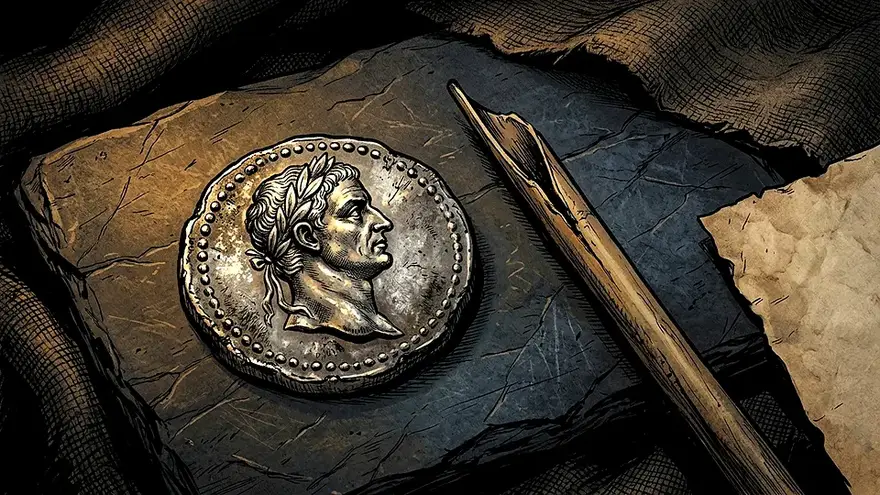
Why Papyrus 115's '616' is the smoking gun for Nero
In Oxyrhynchus, Egypt, archaeologists unearthed Papyrus 115 (3rd century CE), where Revelation 13:18 reads 616 instead of 666—a variant Church Father Irenaeus also knew around 180 CE.
Write Greek Neron Kaisar in Hebrew letters (נרון קסר) and it totals 666. Write Latin Nero Caesar (נרו קסר, without the final Nun = 50) and it totals 616! No coincidence on earth explains a 50-point manuscript split matching the exact Greek-to-Latin spelling of Nero.
1 Kings 10:14 (Old Testament Echo)“Now the weight of gold that came to Solomon in one year was 666 talents of gold.”
Why 'right hand or forehead' mirrors Deuteronomy 6
Even the location of the mark in Revelation 13:16 isn't random sci-fi hardware—it is a deliberate dark parody of the Jewish Shema prayer in Deuteronomy 6:8.
Just as faithful Jews bound God's words on their hand and forehead as a sign of loyalty, Revelation pictures empire demanding rival allegiance in commerce and daily life.
Deuteronomy 6:8 vs. Revelation 13:16“Deut 6:8 — 'Bind them as a sign on your hand, and as frontlets between your eyes.'”
Why ancient Greek manuscripts never wrote '6-6-6' as three repeated digits
Modern movies treat three sixes in a row like a spooky slot-machine sequence. Yet Arabic numerals didn't exist in first-century Greece.
In the earliest Revelation manuscripts, 666 is written as three totally different Greek letters—Chi (600), Xi (60), and Stigma (6)—reinforcing that John intended a name's total value, not a visual symbol.
Revelation 13:17“So that no one can buy or sell unless he has the mark, that is, the name of the beast or the number of its name.”
666 vs. 616: Watch Ancient Letter-Math Solve the Riddle
In ancient Hebrew and Greek, every letter doubled as a number. Tap any name below to see how first-century readers added it up.
Emperor Nero's Greek title (Neron Kaisar) spelled in first-century Hebrew/Aramaic letters—found on an actual Dead Sea scroll at Murabba'at—adds up to 50 + 200 + 6 + 50 + 100 + 60 + 200 = 666.
Read the 666 Story →Why the 666 / 616 Manuscript Split Proves the Nero Calculation
A single final Greek letter ('n' = 50) explains both ancient manuscript traditions simultaneously.
| Manuscript / Spelling | Underlying Form | Hebrew Transliteration | Exact Letter Sum |
|---|---|---|---|
| Majority Greek MSS (χξϛ) | Greek: Neron Kaisar | נרון קסר (NRWN QSR) | 50+200+6+50+100+60+200 = 666 |
| Papyrus 115 & Codex Ephraemi (χιϛ) | Latin: Nero Caesar | נרו קסר (NRW QSR) | 50+200+6+100+60+200 = 616 |
| Old Testament Royal Echo | King Solomon's Tax (1 Kgs 10:14) | 666 talents of gold/year | Warning of corrupt imperial excess |
What to Remember
- Graffiti preserved under Pompeii's 79 CE volcanic ash reads: 'I love her whose number is 545'—proving ordinary 1st-century readers used name-sum riddles.
- A random copyist slip cannot accidentally turn 666 into 616 while simultaneously matching the exact 50-point difference between Greek Neron and Latin Nero in Hebrew.
- In Greek manuscripts, 666 (χξϛ) and 616 (χιϛ) were written as three numeral letters, not three repeated Arabic digits.