
The Book of Hebrews is strictly anonymous in all earliest Greek manuscripts, and both 3rd-century scholar Origen and modern historians agree the Apostle Paul did not write it—especially since Hebrews 2:3 places its author among second-generation believers taught by eyewitnesses (contra Galatians 1:12). Leading candidates from Paul's circle include Barnabas, Apollos of Alexandria, Luke, and Priscilla.
Why older KJV headers said 'Paul'—and why Greek style says otherwise
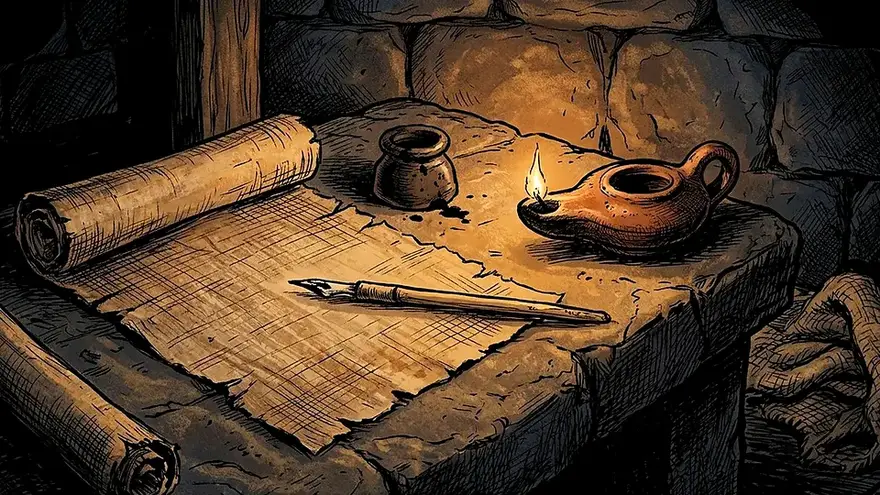
Open an old 1611 King James Bible and the printed page title reads 'The Epistle of Paul the Apostle to the Hebrews.' Yet check the earliest surviving copy on earth—Papyrus 46 (~200 CE)—and the Greek title reads simply Pros Hebraious ('To the Hebrews'), with zero author attached!
Every single one of the thirteen letters bearing Paul's name opens with the exact same Greek word: Paulos. Hebrews has no sender, no recipient address, and no opening thanksgiving—instead, it launches into a breathtaking periodic Greek sentence stringing five alliterative p-words across Hebrews 1:1 (Polymerōs kai polytropōs palai...). Even in antiquity, Greek-speaking scholars noticed Paul's rapid, dictated prose sounded nothing like Hebrews' polished classical cadence.
Hebrews 1:1–2“Long ago, at many times and in many ways (Polymerōs kai polytropōs), God spoke to our fathers by the prophets, but in these last days he has spoken to us by his Son.”
Why It Matters: Whereas Paul opens every single one of his thirteen letters with 'Paul' and fiercely insists in Galatians 1:11–12 that no human taught him the gospel, Hebrews bears zero author's name in ancient Greek manuscripts and places itself among second-generation converts.
Scrolls & Archaeology: In Chester Beatty Papyrus II (P46, copied c. 200 CE, the oldest manuscript of Paul's corpus), ΠΡΟΣ ΕΒΡΑΙΟΥΣ sits right after Romans solely because Alexandrian scribes ordered letters by descending length—not because its text claimed Paul's pen. Around 245 CE, Alexandrian textual giant Origen (preserved in Eusebius, Church History 6.25.11–14) contrasted Paul's abrupt, conversational dictation against Hebrews' classical rhetorical periods and famously concluded, 'Who wrote the epistle, in truth God knows.'

The smoking gun in Hebrews 2:3 vs. Galatians 1:12
Beyond vocabulary and Septuagint-only Old Testament quotations, one verse in chapter 2 settles the case against Paul for nearly every historian. In Galatians 1:11–12, Paul insists under oath: 'I did not receive it from any man, nor was I taught it, but I received it through a revelation of Jesus Christ.'
Now read Hebrews 2:3: salvation 'was declared at first by the Lord, and it was attested to us by those who heard' (hypo tōn akousantōn). The author openly stands in the second generation taught by eyewitnesses—and builds thirteen chapters around Christ as High Priest after Melchizedek, a title Paul never uses once.
Hebrews 2:3“How shall we escape if we neglect such a great salvation? It was declared at first by the Lord, and it was attested to us by those who heard.”
Clues at the end of the scroll: Barnabas, Apollos, Luke, or Priscilla?
Thankfully, the closing note in Hebrews 13:22–25 drops vital clues: the writer calls the book a 'word of exhortation' (logos tēs paraklēseōs—Acts 13:15's phrase for a synagogue sermon), greets 'those from Italy,' and reports 'our brother Timothy has been released.'
That puts our mystery preacher inside Paul's circle. Around 200 CE, Tertullian named Barnabas—a Cypriot Levite (Acts 4:36) nicknamed 'Son of Exhortation.' Martin Luther proposed Apollos of Alexandria, famed for Greek eloquence and scriptural mastery (Acts 18:24); Clement suggested Luke; and Adolf von Harnack proposed Priscilla (Acts 18:26), though Hebrews 11:32 uses a masculine Greek participle (diēgoumenon) for the speaker.
Hebrews 13:22–24“I appeal to you, brothers, bear with my word of exhortation, for I have written to you briefly. You should know that our brother Timothy has been released... Those who come from Italy send you greetings.”

Origen's timeless verdict: 'In truth, only God knows'
Around 240 CE, the greatest biblical philologist of the early church—Origen of Alexandria (preserved in Eusebius, Church History 6.25.11–14)—weighed every clue and delivered the most honest line in patristic scholarship. Anyone capable of judging literary style, Origen wrote, must admit Hebrews' Greek composition is far more Hellenistic than Paul's—perhaps a disciple wrote down apostolic thoughts from memory.
'Who actually wrote the epistle,' Origen concluded, 'in truth only God knows' (to men alēthes theos oiden). Ironically, Hebrews' anonymity fits its opening line like a glove: human messengers fade into the background so listeners fix their eyes solely on God's final Word—His Son.
Eusebius, Church History 6.25.14 (Quoting Origen)“If any church holds this epistle to be Paul's, let it be commended for this also... Yet who actually wrote the epistle, in truth only God knows.”
Suspect Lineup: Weighing the Five Leading Candidates for Hebrews
Every serious contender belongs to the 1st-century Pauline-Timothean missionary circle prior to (or shortly after) Jerusalem's Temple destruction in 70 CE.
| Candidate | Earliest Champion | Strongest Evidence For | Biggest Hurdle |
|---|---|---|---|
| Apollos | Martin Luther (1522) | Native of Alexandria (steeped in LXX & typological Greek rhetoric); 'eloquent & competent in Scriptures' (Acts 18:24) | Zero ancient church father explicitly names Apollos |
| Barnabas | Tertullian (~200 CE) | Actual Levite (Acts 4:36); nicknamed 'Son of Exhortation' (matching Heb 13:22); direct ancient attestation | Second-century 'Epistle of Barnabas' looks completely unlike Hebrews |
| Luke | Clement of Alexandria (~190 CE) | Writes the closest literary Greek in the NT (cf. Luke 1:1–4; Acts 7); close companion of Timothy | Luke was a Gentile Christian, whereas Hebrews breathes deep Jewish liturgical instinct |
| Priscilla (Prisca) | Adolf von Harnack (1900) | Taught Apollos himself (Acts 18:26); linked with Rome/Italy & Timothy; explains suppressed name | Hebrews 11:32 uses masculine singular participle diēgoumenon ('if I go on telling') |
| Paul | Eastern Greek lists / KJV header | Mentions 'our brother Timothy' (13:23); placed inside P46's Pauline codex | Contradicts Heb 2:3 (second-generation hearer); utterly non-Pauline Greek & High Priest theme |
What to Remember
- Unlike all thirteen Pauline epistles, Hebrews omits any sender's name, writes the most classical rhetorical Greek in the New Testament, and calls itself a 'word of exhortation' (sermon).
- Hebrews 2:3 openly says the author received the gospel secondhand from those who heard Jesus—the exact opposite of Paul's fierce oath in Galatians 1:11–12.
- Because Hebrews 13:23 mentions 'our brother Timothy,' the unknown genius belonged to Paul's missionary network—pointing to Barnabas, Apollos, Luke, or Priscilla.