First Enoch (1 Enoch) is a five-part Second Temple Jewish apocalyptic anthology compiled in Aramaic between roughly 300 BCE and the 1st century CE, expanding Genesis 5–6's story of Enoch and the fallen Watchers. Quoted directly in Jude 1:14–15 and unearthed in eleven Aramaic manuscripts at Qumran (4Q201–4Q212), it remains canonical Scripture today inside the Ethiopian and Eritrean Orthodox Tewahedo Churches.
Four mysteries in Genesis 5:24—and a five-book ancient library
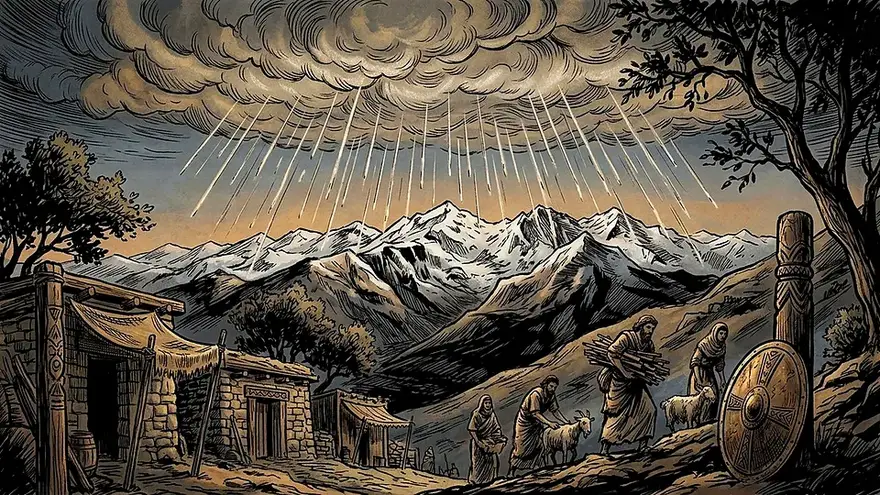
Genesis 5 marches through a drumbeat of mortality—'and he died... and he died'—until verse 24 stops cold at generation seven: 'Enoch walked with God, and he was not, for God took him.' Ancient Jewish readers wanted to know everything: Where did God take Enoch, and what secrets of heaven and earth did he see?
Between roughly 300 BCE and the 1st century CE, Jewish scribes answered with five distinct scrolls eventually bound together as 1 Enoch (108 chapters): the Book of the Watchers (chs. 1–36), the Parables/Similitudes (37–71), the Astronomical Book (72–82), the Animal Apocalypse (83–90), and the Epistle of Enoch (91–108).
Genesis 5:24“Enoch walked with God, and he was not, for God took him.”
Why It Matters: KJV's 'ten thousands of his saints' made English readers picture canonized Christian believers, whereas Greek hagiois myriasin and Qumran Aramaic qaddishohi quote 1 Enoch 1:9's heavenly army of angelic 'holy ones' echoing Deuteronomy 33:2.
Scrolls & Archaeology: Published by Józef Milik in 1976, eleven Aramaic Enoch manuscripts from Qumran Cave 4 (4Q201–4Q212, oldest 4Q201 copied c. 200–150 BCE) proved the Book of Watchers pre-dated Christianity by centuries while conspicuously lacking 1 Enoch's 'Similitudes/Parables' section (chapters 37–71). In Europe, complete 1 Enoch was presumed lost for over a millennium until Scottish explorer James Bruce returned from Ethiopia in 1773 carrying three Ge'ez parchment codices (including Oxford's Bodleian MS Bruce 74).
Jude 1:14–15 and Qumran Cave 4's eleven Aramaic scrolls
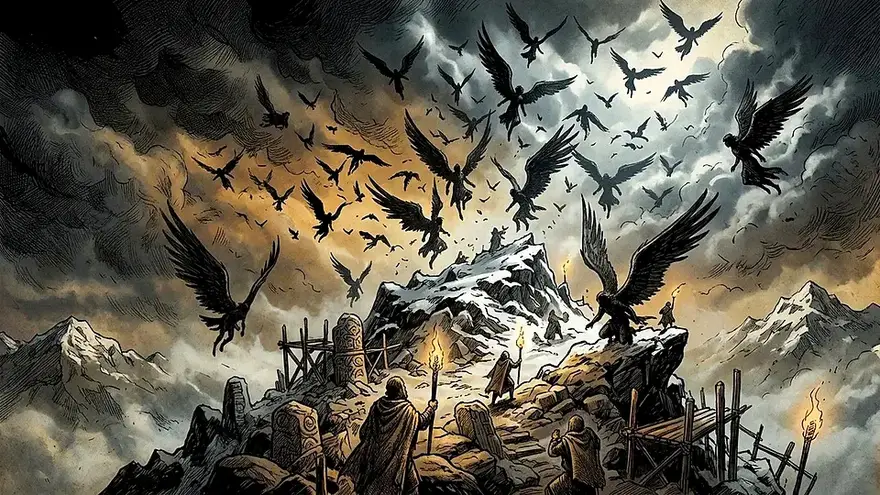
How influential was 1 Enoch in the world of Jesus and the apostles? Turn to Jude 1:14–15 in any New Testament and compare it against 1 Enoch 1:9: Jude introduces 'Enoch, the seventh from Adam' and quotes Enoch's judgment oracle word-for-word, while Jude 1:6 and 2 Peter 2:4 echo Enoch's story of rebel Watchers chained beneath darkness!
For centuries skeptics wondered whether a Christian forged 1 Enoch after Jude. Then in 1952, Bedouin and archaeologists recovered fragments of eleven Aramaic Enoch scrolls from Qumran Cave 4 (4Q201–4Q212), paleographically dated as early as 200 BCE—including Aramaic fragments of 1 Enoch 1:9 itself (4Q204).
Jude 1:14–15 (Quoting 1 Enoch 1:9)“It was also about these that Enoch, the seventh from Adam, prophesied, saying, 'Behold, the Lord comes with ten thousands of his holy ones, to execute judgment on all...'”
Why both rabbinic Judaism and Western Christianity dropped 1 Enoch
If Qumran Essenes copied eleven Enoch scrolls and early Christian writers like Tertullian revered it, why did 1 Enoch vanish from Jewish and European Bibles? After Rome crushed Jerusalem in 70 and 135 CE, rabbinic sages grew deeply wary of apocalyptic movements, solar calendars (Enoch's 364-day year clashed with the Temple's lunar-solar calendar), and stories of angels mating with women.
In the Latin West, Jerome dismissed Enoch as apocryphal and Augustine argued in City of God (15.23) that since Jews hadn't preserved Enoch in the Hebrew Temple canon, nobody could verify antediluvian authorship—noting Paul also quoted pagan Greek poets in Acts 17:28 and Titus 1:12 without making their books Scripture.
2 Peter 2:4“For if God did not spare angels when they sinned, but cast them into hell (tartarōsas) and committed them to chains of gloomy darkness to be kept until the judgment...”
Saved in the highlands of Ethiopia until James Bruce arrived in 1773
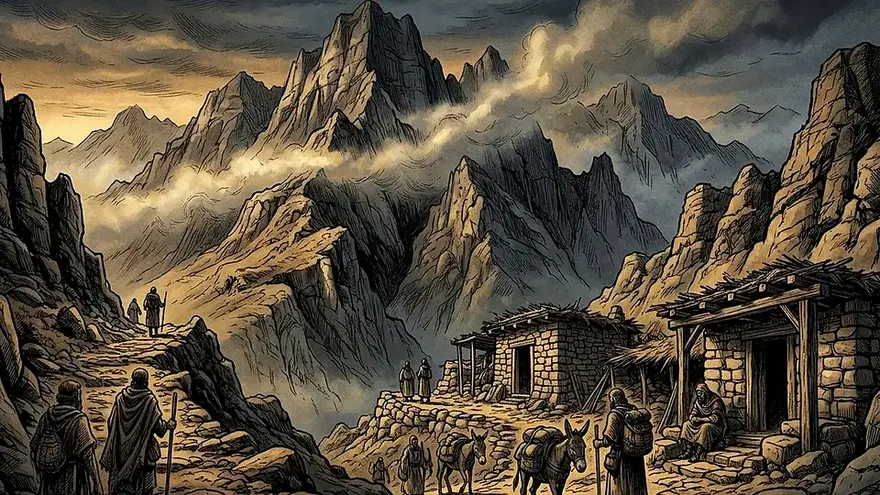
Across Europe and the Middle East, complete copies of 1 Enoch disappeared for over a thousand years, surviving only in scattered Greek and Syriac excerpts. Yet high in East Africa, the ancient Ethiopian Orthodox Tewahedo Church (along with the Eritrean Orthodox Church) never dropped Mashafa Henok from its 81-book Bible, preserving all 108 chapters in classical Ge'ez.
In 1773, Scottish explorer James Bruce returned from Abyssinia to Europe carrying three complete Ge'ez manuscripts of 1 Enoch. When Richard Laurence published the first English translation in 1821, scholars realized they were holding the missing backdrop to Second Temple angelology and New Testament apocalyptic imagery.
1 Enoch 46:1, 3 (Book of Parables)“And there I saw One who had a head of days... and with Him was another being whose countenance had the appearance of a man... This is the Son of Man who hath righteousness.”
Inside '1 Enoch': The Five Ancient Books Bound as One
Notice how Qumran's Aramaic Dead Sea Scrolls attested four of the five sections—leaving the 'Son of Man' Parables as a lively 1st-century Jewish dating debate.
| Section of 1 Enoch | Chapters | Approx. Date | Found at Qumran? & Core Theme |
|---|---|---|---|
| 1. Book of the Watchers | Chs. 1–36 | 3rd c. BCE | Yes (4Q201–202, 204–206) · 200 angels descend on Mt. Hermon; giant Nephilim; cosmic tours |
| 2. Book of Parables (Similitudes) | Chs. 37–71 | 1st c. BCE – 1st c. CE | No Qumran fragments found · Heavenly 'Son of Man' / 'Elect One' judging kings |
| 3. Astronomical Book | Chs. 72–82 | Late 4th–3rd c. BCE | Yes (4Q208–211, oldest!) · Uriel reveals sun/moon gates and a strict 364-day solar calendar |
| 4. Book of Dream Visions | Chs. 83–90 | ~165–160 BCE | Yes (4Q204–207) · 'Animal Apocalypse' retelling biblical history from Adam to Judas Maccabeus |
| 5. Epistle of Enoch | Chs. 91–108 | 2nd c. BCE | Yes (4Q204, 4Q212) · Apocalypse of Weeks and woes against wealthy oppressors |
What to Remember
- First Enoch isn't a single book—it is a five-volume Second Temple anthology spanning the Book of the Watchers, Parables, Astronomical Book, Dream Visions, and Epistle of Enoch.
- Jude 1:14–15 quotes 1 Enoch 1:9 nearly word-for-word, proving first-century Jewish Christians treasured Enochic literature even without universally treating all 108 chapters as Torah.
- Lost in Europe for over a millennium after rabbis and Latin Fathers sidelined it, complete 1 Enoch survived in classical Ge'ez inside Ethiopia's 81-book Orthodox canon.