The ’Urim wĕ-Thummim (אוּרִים וְתֻמִּים, 'Lights and Perfections') were sacred divinatory lots kept inside the High Priest's breastpiece of judgment (Exodus 28:30) to obtain binary verdicts from God during national crises. While Exodus omits their physical blueprint, the fuller Greek Septuagint reading of 1 Samuel 14:41 shows how they cast 'yes/no' answers before disappearing in 586 BCE.
No blueprint in Exodus—and a name spanning Aleph (א) to Tav (ת)
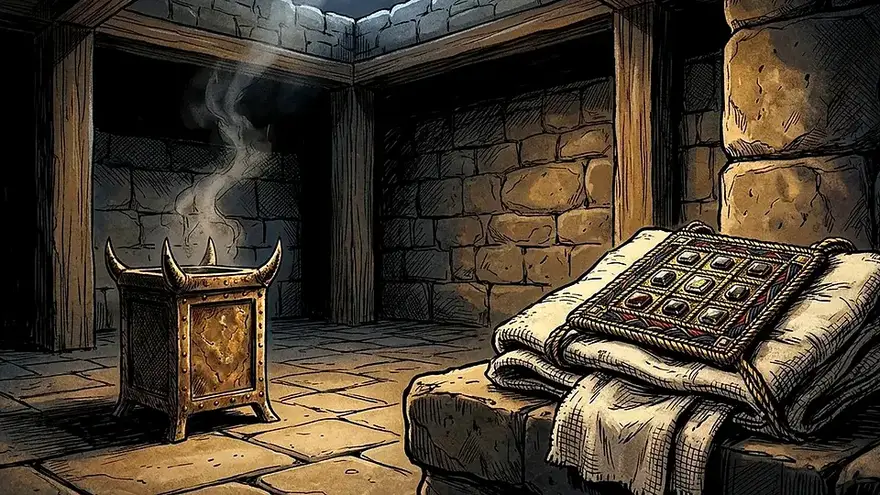
Exodus 25–28 measures every golden ring, acacia pole, and woven pomegranate bell of the Tabernacle down to fractions of a cubit. Yet when Exodus 28:30 reaches the Urim and Thummim, no artisan instructions appear at all—Moses is simply told to 'put in the breastpiece of judgment the Urim and the Thummim,' tucked inside the nine-inch folded linen pouch resting over Aaron's heart.
Notice their Hebrew initials: ’Urim (אוּרִים, 'Lights') starts with Aleph (א), the first letter of the Hebrew alphabet, while Thummim (תֻּמִּים, 'Perfections/Integrity') starts with Tav (ת), the final letter—an A-to-Z merism signifying whole, unclouded truth.
Exodus 28:30“And in the breastpiece of judgment you shall put the Urim and the Thummim, and they shall be on Aaron's heart, when he goes in before the LORD.”
Why It Matters: A classic scribal eye-skip (homoioteleuton) between two occurrences of 'Israel' in Hebrew manuscripts accidentally deleted twenty-six words from 1 Samuel 14:41—preserved intact in the older Greek Septuagint—showing exactly how Urim and Thummim worked!
Scrolls & Archaeology: In Codex Vaticanus (B) at 1 Kingdoms 14:41, the preserved Greek clause jumps between repeated 'LORD God of Israel' endings, textbook proof of accidental omission in the proto-Masoretic ancestor rather than Greek invention. Notice also the Hebrew alphabetic merism: 'Urim begins with Aleph (א, the first letter of the Hebrew alphabet, evoking 'arur, 'cursed/guilty') while Thummim begins with Tav (ת, the last letter, evoking tamim, 'innocent/blameless').
How a scribal eye-skip in 1 Samuel 14:41 preserves their operating manual
How did the High Priest read an answer? Centuries after they vanished, Josephus and the Babylonian Talmud (Yoma 73b) imagined letters lighting up across the breastplate's twelve tribal gemstones, while Dead Sea Scroll 4Q376 pictured flashing tongues of fire.
Earlier biblical evidence points somewhere much simpler. In Masoretic Hebrew 1 Samuel 14:41, a copyist's eye jumped between two identical occurrences of the word 'Israel,' accidentally dropping twenty words still preserved in the older Greek Septuagint (LXX): King Saul prays, 'If this guilt is in me or my son Jonathan, O LORD God of Israel, give Urim; and if it says thus, in Your people Israel, give Thummim!' They worked as two distinct sacred lots.
1 Samuel 14:41 (Full Septuagint / NRSV Reading)“'O LORD God of Israel, why have you not answered your servant today? If this guilt is in me or in my son Jonathan, O LORD God of Israel, give Urim; but if this guilt is in your people Israel, give Thummim.'”
Binary war-room questions—and terrifying silence before Saul's death
Unlike pagan Mesopotamian hepatoscopy (reading sheep livers), Israelite law restricted Urim to Israel's national leader standing before the High Priest (Numbers 27:21) with crisp, one-step binary questions. Watch young David consult Abiathar the priest in 1 Samuel 23:10–12 and 30:8: first, 'Will Saul come down?' ('He will come down'); second, 'Will the men of Keilah surrender me?' ('They will surrender you').
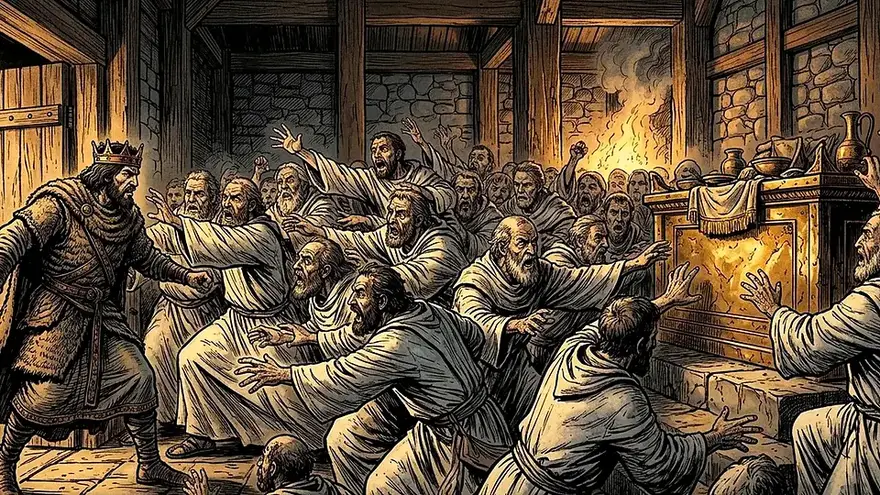
Apparently a third outcome was also possible: dead silence—perhaps if both stones emerged together or neither answered. On the eve of his final battle in 1 Samuel 28:6, 'the LORD did not answer Saul, neither by dreams, nor by Urim, nor by prophets,' driving desperate Saul to Endor.
1 Samuel 30:7–8 & 1 Samuel 28:6“1 Sam 30:8 — 'David inquired of the LORD, "Shall I pursue after this band? Shall I overtake them?" He answered him, "Pursue."' · 1 Sam 28:6 — 'The LORD did not answer him... by Urim.'”
Missing after 586 BCE: Why the Second Temple waited in vain
Once Solomon built the First Temple and prophetic giants like Nathan, Elijah, and Isaiah spoke God's counsels directly, kings stopped reaching for sacred lots. After Nebuchadnezzar burned Jerusalem in 586 BCE, the Urim and Thummim vanished from history alongside the Ark of the Covenant.
When Jewish exiles returned from Babylon around 538 BCE, families unable to prove priestly lineage were barred from sacred food 'until a priest should arise with Urim and Thummim' (Ezra 2:63; Nehemiah 7:65). No such priest ever appeared; Talmudic tractate Sotah 48b openly records that throughout the entire Second Temple era, Urim and Thummim ceased.
Ezra 2:63“The governor told them that they were not to partake of the most holy food, until there should be a priest to consult Urim and Thummim.”
Ancient Evidence on How the Urim and Thummim Functioned
Tracing Urim and Thummim from early Torah & Samuel lot-casting to Second Temple memory.
| Source | Era | How Consultation Is Described | Historical Status |
|---|---|---|---|
| Exodus 28:30 / Num 27:21 | Wilderness / Torah | Placed inside High Priest's folded breastpiece pouch for national decisions | Active priestly institution |
| 1 Samuel 14:41 (LXX) & 23:9–12 | United Monarchy | Binary two-option lot inquiry ('Give Urim... or give Thummim') | Used regularly by Saul and young David |
| Ezra 2:63 / Nehemiah 7:65 | Post-Exilic (538 BCE) | Hoped-for future restoration to settle disputed priestly genealogies | Lost after 586 BCE Babylonian destruction |
| Qumran 4Q376 / Josephus / Yoma 73b | Late Second Temple & Rabbinic | Reimagined as glowing breastplate gemstones spelling words | Retrospective tradition centuries after cessation |
What to Remember
- Spelled beginning with Aleph (א, ’Urim) and Tav (ת, Thummim), their twin names span the Hebrew alphabet from A to Z to signify complete, clear truth.
- An ancient copyist eye-skip in Masoretic 1 Samuel 14:41—preserved intact in the Greek Septuagint—proves they operated as binary cast lots rather than magic crystal balls.
- After Babylon destroyed Jerusalem in 586 BCE, Ezra 2:63 and Talmudic records confirm the Second Temple never recovered active Urim and Thummim.