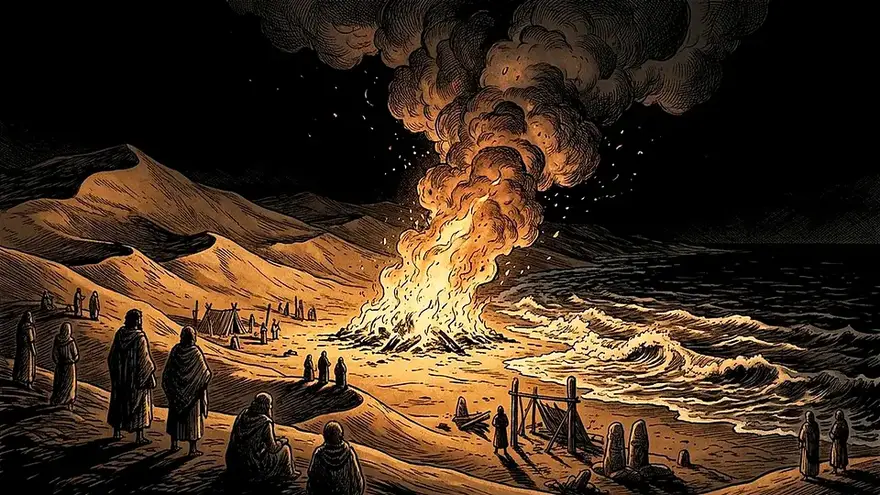
In Genesis 19:26, Lot's wife did far more than flinch at a loud noise; the Hebrew phrase wattabbet ishto me-acharav means she lagged behind Lot and 'gazed intently backward' in longing despite the angels' warning (19:17). Overtaken by Sodom's fiery sulfur-and-brine fallout beside the Dead Sea's hypersaline cliffs, she became a 'pillar of salt' (netziv melach)—invoked by Jesus in Luke 17:32.
Not a startled reflex: what Hebrew 'wattabbet me-acharav' reveals
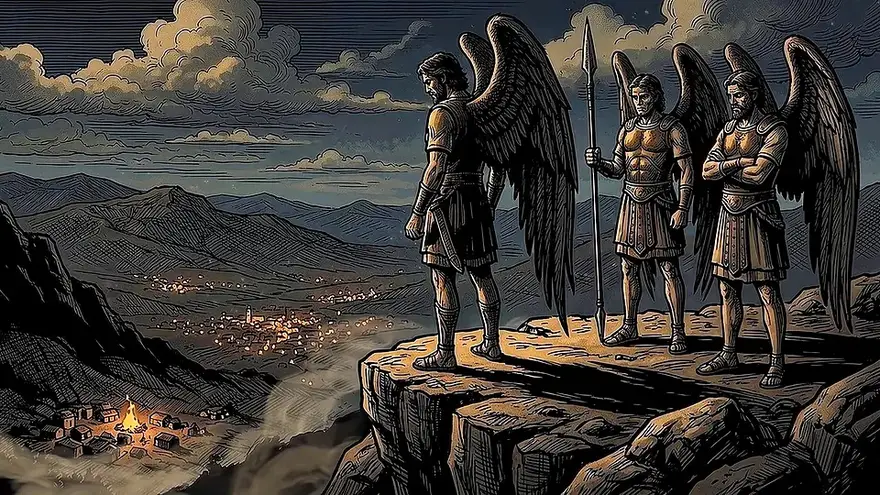
Readers often wonder whether God struck a terrified refugee dead just for flinching at thunder. Look closely at Genesis 19:16–26 in Hebrew and the scene shifts sharply. At dawn, Lot's household lingered so long inside doomed Sodom that two angels grabbed all four people by the wrist and dragged them outside the gate, shouting: 'Escape for your life! Do not look back or stop anywhere in the valley!'
In verse 26, wattabbet ishto me-acharav pairs nabat ('to gaze intently with longing') with 'from behind him [Lot].' Trailing at the rear, she stopped and turned back toward Sodom—straight into the descending storm.
Genesis 19:17, 26“Genesis 19:17 — 'Escape for your life. Do not look back (al-tabbit acharekha) or stop anywhere in the valley.' · Genesis 19:26 — 'But Lot's wife, behind him, looked back (wattabbet), and she became a pillar of salt.'”
Why It Matters: English 'looked back' sounds like an innocent split-second startle at thunder, whereas Hebrew Hiphil nabat means 'to fix one's gaze with longing' and 'from behind him' reveals she had trailed backward into the Dead Sea rift's lethal fallout—exactly how Jesus interprets her in Luke 17:31–32!
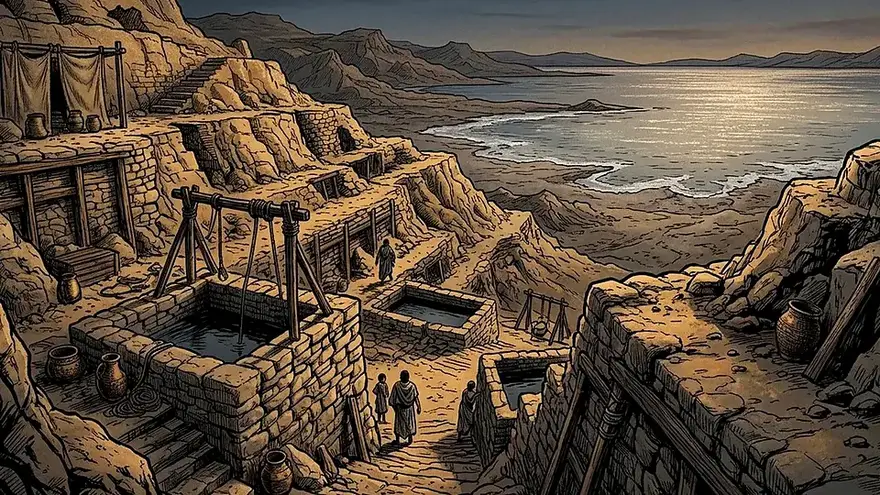
Scrolls & Archaeology: Towering along the southwestern Dead Sea basin, Jebel Usdum (Mount Sodom) is an exposed 7-mile diapir wall of solid rock salt whose rain-sculpted halite pillars inspired continuous ancient pilgrimage, cited in 1st-century BCE Wisdom of Solomon 10:7 ('a pillar of salt standing as a monument to an unbelieving soul'). First-century historian Josephus (Antiquities 1.203) even claimed he had personally viewed the salt formation standing in his own lifetime.
Dead Sea Rift chemistry and the five-mile salt wall of Jebel Usdum
Why salt rather than ash or stone? Step onto the southwestern shore of the Dead Sea—Earth's lowest exposed fault line at 1,400 feet below sea level—and geology answers immediately. Towering above the water stands a five-mile-long ridge still called in Arabic Jebel Usdum ('Mount Sodom'), pushed up from an underground Miocene salt bed and composed of eighty percent crystalline rock salt (halite).
Geologists studying the Dead Sea Transform fault note that major rift earthquakes violently ignite underground bitumen, methane gas, sulfur (gofrit), and hypersaline brine. Anyone lingering on that plain during a seismic sulfur-and-brine eruption would be asphyxiated and encrusted in salt.
Genesis 19:24–25 & Deuteronomy 29:23“Genesis 19:24 — 'Then the LORD rained on Sodom and Gomorrah sulfur (gofrit) and fire.' · Deuteronomy 29:23 — 'The whole land burned out with brimstone and salt, nothing sown and nothing growing, like the overthrow of Sodom.'”
First-century tourists at the salt column: Wisdom 10:7 and Flavius Josephus
Throughout the Second Temple and Roman eras, travelers hiking past Jebel Usdum pointed out jagged, human-shaped halite pinnacles calved off the salt cliff by winter rains. Around the first century BCE, the Greek Jewish author of Wisdom of Solomon 10:7 wrote that Sodom's smoking wasteland still bore 'a standing pillar of salt, a monument to an unbelieving soul.'
A century later in Rome (~93 CE), Jewish general and historian Flavius Josephus went further in Jewish Antiquities 1.203, writing of Lot's wife turning into a salt pillar: 'I have seen it, and it remains at this very day.' Early Christian bishop Clement of Rome (1 Clement 11:2) and traveler Egeria echoed the famous Dead Sea landmark.
Wisdom of Solomon 10:6–7 (Deuterocanon)“Wisdom rescued a righteous man when the ungodly were perishing; he escaped the fire that descended on the Five Cities. Evidence of their wickedness still stands: a continually smoking wasteland... and a pillar of salt standing as a monument.”
Why Jesus distilled her story into three Greek words in Luke 17:32
Alongside 'Jesus wept' (John 11:35), Luke 17:32 is one of the shortest, sharpest sentences in the New Testament: Mnēmoneuete tēs gynaikos Lōt—'Remember Lot's wife.' Notice she has no personal name anywhere in Genesis or the Gospels, turning her silhouette into a universal mirror for every reader.
Jesus invokes her right after warning that when sudden crisis strikes, 'the one on the housetop, with his goods in the house, must not come down to take them away' (Luke 17:31–33). Physically, Lot's wife made it outside Sodom's city wall; spiritually, Sodom never left her heart, and trying to salvage yesterday's doomed comfort cost her tomorrow.
Luke 17:31–33“On that day, let the one who is on the housetop, with his goods in the house, not come down to take them away... Remember Lot's wife. Whoever seeks to preserve his life will lose it, but whoever loses his life will keep it.”
Four Ancient Witnesses to Lot's Wife & the Dead Sea Salt Landscape
How Torah, Deuterocanonical wisdom, Roman-era history, and the Gospels read Genesis 19:26.
| Source & Date | Key Phrase / Detail | Main Emphasis |
|---|---|---|
| Genesis 19:17, 26 (Torah) | Wattabbet... netziv melach ('gazed back... salt pillar') | Lagging behind in disobedience during sulfur-and-brine judgment |
| Wisdom 10:7 (~1st c. BCE) | 'Monument to an unbelieving soul' | Physical Dead Sea salt column as enduring moral warning |
| Josephus, Ant. 1.203 (~93 CE) | 'I have seen it, and it remains today' | First-century eyewitness visit to Jebel Usdum's halite pinnacle |
| Luke 17:31–33 (Jesus) | 'Remember Lot's wife' (Mnēmoneuete...) | Urgent call to let go of worldly possessions when judgment arrives |
What to Remember
- Hebrew wattabbet (from nabat) denotes a deliberate, lingering gaze—showing she lagged behind Lot (me-acharav) clinging to Sodom's wealth and social ties until fallout overtook her.
- Along the southwestern Dead Sea rises Jebel Usdum ('Mount Sodom'), a five-mile diapir of 80% pure rock salt whose eroded halite columns were visited by Josephus in the first century CE.
- In Luke 17:32, Jesus turns her fate into a three-word Greek proverb ('Remember Lot's wife') warning disciples never to turn back for possessions when judgment breaks.