The four Gospels never describe Jesus's facial features, height, or eye color—yet Galilean archaeology and incidental Gospel clues build a vivid first-century portrait. Jesus stood roughly 5'5" with sun-weathered olive-brown skin, dark eyes, short hair and a trimmed beard (1 Corinthians 11:14), a knee-length seamless wool tunic (chitōn), leather sandals, and blue-threaded Torah tassels (kraspedon / tzitzit, Mark 6:56).
Why Judas needed a prearranged sign—and what Galilean skeletons reveal
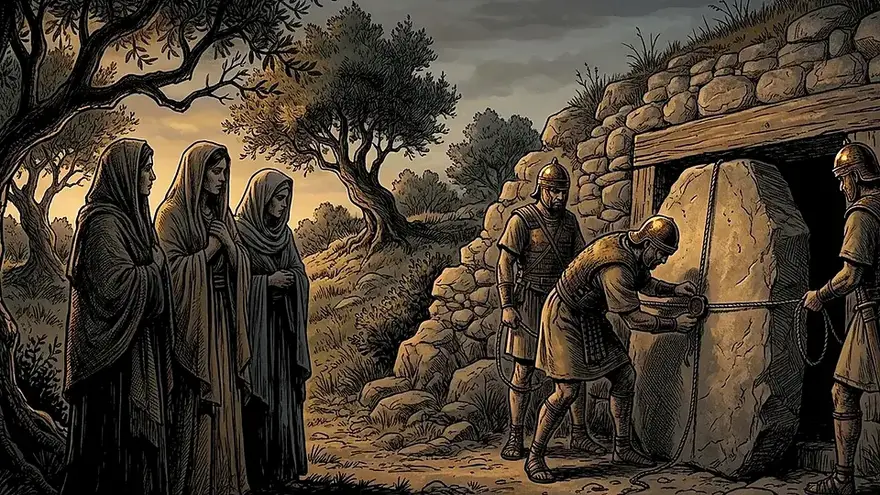
Roman biographers like Suetonius recorded emperors' exact heights, noses, and hairlines down to the wrinkle, yet Matthew, Mark, Luke, and John skip Jesus's face completely. Gethsemane explains why: standing by torchlight among eleven Galilean companions, nothing physical set Jesus apart—arresting guards needed Judas's kiss just to identify Him (Mark 14:44).
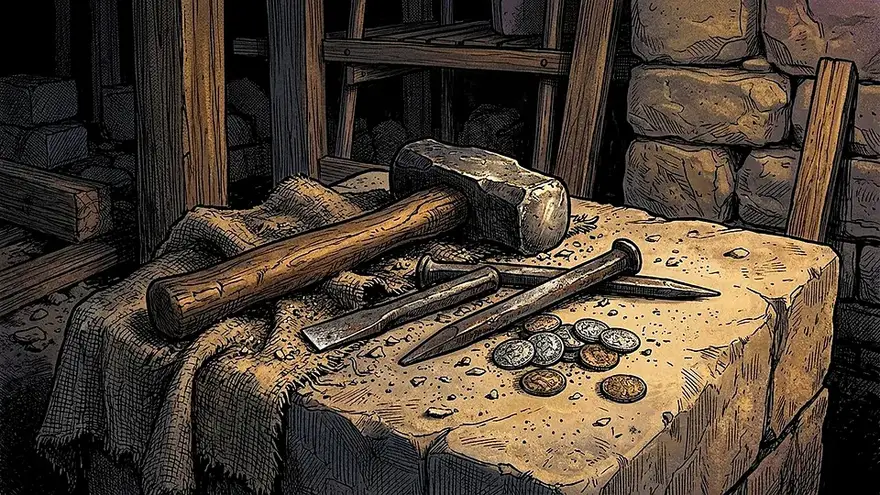
First-century Jewish skeletal remains excavated across Galilee and Jerusalem—analyzed by forensic anthropologist Richard Neave and historian Joan Taylor—put the average Semitic male at 5 feet 5 inches (166 cm) and roughly 140 pounds. Twenty years working outdoors as a tektōn (stone-and-timber builder) and walking hill roads left Jesus lean, muscular, and olive-brown.
Mark 14:44 & Isaiah 53:2“Mark 14:44 — 'Now the betrayer had given them a sign, saying, The one I will kiss is the man.' · Isaiah 53:2 — 'He had no form or majesty that we should look at him.'”
Why It Matters: KJV's 'hem/border of his garment' inspired centuries of European paintings showing Jesus in ankle-length sewn robes, whereas Greek kraspedon is the exact Septuagint word for Numbers 15:38's knotted wool tzitzit tassel hanging from a knee-length Judean cloak!
Scrolls & Archaeology: During Yigael Yadin's 1960–1961 expedition to Nahal Hever's Cave of Letters beside the Dead Sea, archaeologists recovered actual early 2nd-century CE Judean rectangular wool mantles woven with L-shaped corner gamma marks and bundles of indigo-and-murex-dyed tzitzit threads matching Numbers 15:38's 'cord of blue' (petil tekhelet). Painted around 235 CE on the baptistery wall of Syria's Dura-Europos house-church (now at Yale University Art Gallery), the oldest surviving non-symbolic painting of Jesus shows Him short-haired, clean-shaven, and wearing a knee-length tunic and mantle with sandals.
Short hair and trimmed beard: why 'Nazarene' never meant long Samson locks
Why do Western portraits give Jesus shoulder-length chestnut locks? Medieval artists confused 'Jesus of Nazareth' (Nazōraios, a Galilean town) with an Old Testament 'Nazirite' like Samson (nazir in Numbers 6, an ascetic vow banning razors and wine). Jesus drank wine at banquets (Matthew 11:19), proving He took no Nazirite vow.
Outside mourning or temporary vows, first-century Jewish men wore cropped hair; Paul treats it as self-evident in 1 Corinthians 11:14 ('If a man wears long hair, it is a disgrace for him'). Roman Judaea Capta coins (71 CE) stamp captive Judean men with short, curly hair and trimmed beards obeying Leviticus 19:27.
1 Corinthians 11:14 & Matthew 11:19“1 Cor 11:14 — 'Does not nature itself teach you that if a man wears long hair it is a disgrace for him?' · Matt 11:19 — 'The Son of Man came eating and drinking.'”
Blue-threaded Torah tassels ('tzitzit') and a knee-length seamless tunic
Erase the floor-length snow-white robes of cinema—in first-century Judea, sweeping ankle-length tunics were worn only by wealthy elites strolling shaded plazas, whom Jesus criticized in Mark 12:38! Working men wore an undyed wool knee-length tunic (chitōn, woven in one piece from the neck down in John 19:23) belted for brisk walking over strapped leather sandals.
Over His tunic, Jesus draped a rectangular wool mantle (himation) fitted at its four corners with knotted tzitzit tassels threaded with blue cord per Numbers 15:38. When sick villagers and the bleeding woman reached for the 'fringe' (kraspedon) of His cloak in Matthew 9:20 and Mark 6:56, they grabbed Jesus's Torah prayer tassels.
Numbers 15:38 & Matthew 9:20“Numbers 15:38 — 'Tell them to make tassels (tzitzit) on the corners of their garments... and to put a cord of blue on the tassel.' · Matt 9:20 — 'A woman... came up behind him and touched the fringe (kraspedon) of his garment.'”
From Dura-Europos's short-haired healer (235 CE) to Byzantine throne icons
Archaeology preserves the oldest surviving Christian painting of Jesus on earth—pulled from a buried house-church at Dura-Europos on the Syrian Euphrates and dated before 256 CE (c. 235 CE). Healing the paralytic, Jesus appears as a young, beardless Mediterranean man with cropped dark hair, a tunic ending at the knees, and sandals.
Why did Christian art transform a century later? Once Constantine legalized the faith in 313 CE, fourth-century mosaic artists in Rome and Constantinople needed instant visual shorthand for 'Supreme Ruler of the Universe'—so they adapted the parted long hair, full royal beard, and golden nimbus long used for enthroned Zeus and Serapis into the majestic Christ Pantocrator icon.
Revelation 1:14–15 (Symbolic Apocalyptic Vision)“The hairs of his head were white, like white wool, like snow. His eyes were like a flame of fire, his feet were like burnished bronze, refined in a furnace.”
Historical First-Century Galilean Jesus vs. Later Artistic Icons
Comparing Gospel clues and Judean archaeology with Dura-Europos (235 CE) and post-Constantinian art.
| Feature | 1st-Century Judean Evidence | Dura-Europos (c. 235 CE) | Byzantine / European Art (350+ CE) |
|---|---|---|---|
| Hair & Beard | Short dark curly hair; trimmed Jewish beard | Short cropped hair; clean-shaven youth | Shoulder-length parted locks; full flowing beard |
| Build & Complexion | ~5'5" sinewy builder's frame; weathered olive skin | Lean Mediterranean traveler | Tall, pale aristocratic court figure |
| Everyday Clothing | Knee-length wool chitōn + cloak with blue tzitzit | Short tunic, mantle, and open sandals | Floor-length imperial purple, red, or white robes |
| Why Depicted Thus | Blended into Galilean crowds (Mark 14:44) | Miracle-working healer & Good Shepherd | Visual rivalry with enthroned Olympian Zeus |
What to Remember
- Gethsemane proves Jesus had no glowing halo or unusual stature: Temple guards required Judas's prearranged kiss to pick Him out of eleven other Galilean fishermen and laborers.
- European paintings gave Jesus long Samson hair by confusing a 'Nazarene' (resident of Nazareth) with an Old Testament 'Nazirite' vow—whereas first-century Jewish men kept hair trimmed above the collar.
- Our oldest surviving painting of Jesus—a 235 CE Syrian house-church fresco at Dura-Europos—shows a short-haired, beardless healer in a knee-length tunic, generations before Byzantine throne icons.