In Genesis 9:22, 'Ham, the father of Canaan, saw the nakedness of his father' (ervat aviv) and mocked him publicly—or, via the Leviticus 18:7–8 idiom, violated his father's marriage tent. Because God had already blessed Ham in Genesis 9:1, Noah directed his oracle (arur Kena'an, v. 25) at Ham's youngest line, Canaan, foreshadowing Canaanite moral corruption and never involving race or skin color.
Inside Noah's vineyard tent: two opposite responses to a fallen father
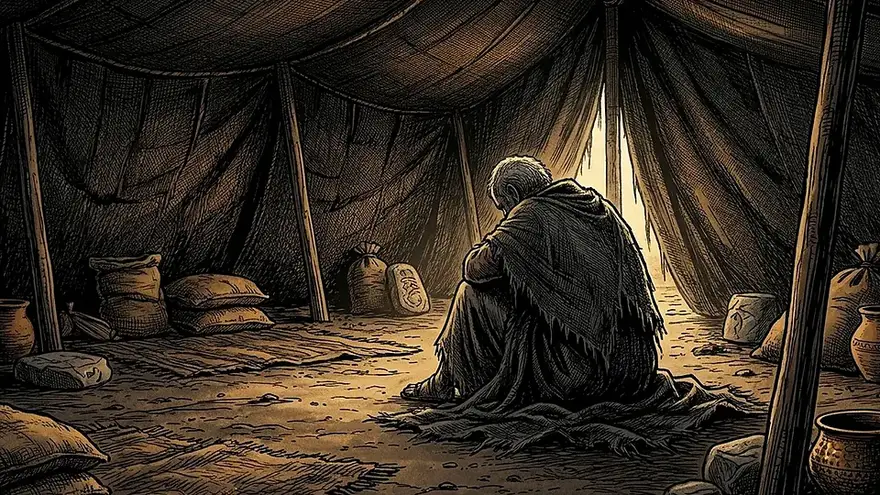
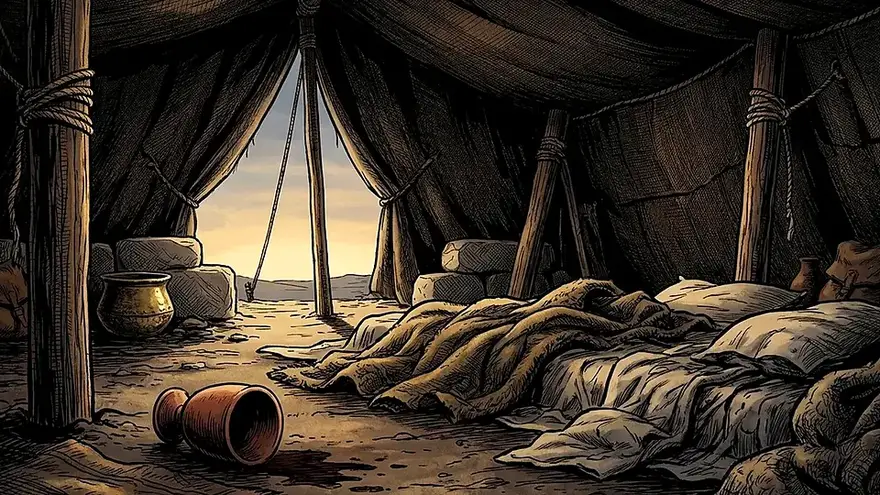
Fresh off the Ark, righteous Noah becomes 'a man of the soil' (ish ha-adamah), plants the Bible's first vineyard, drinks himself unconscious, and lies uncovered inside his tent. Notice a striking replay of Eden: Adam ate fruit and discovered shameful nakedness; now the second Adam drinks fermented grape juice and lies exposed (wayyitgal).
When middle son Ham steps in, he stares at 'the nakedness of his father' (ervat aviv) and marches outside to broadcast the spectacle to his brothers rather than covering him. Shem and Japheth do the exact reverse—draping a cloak across both their shoulders, walking backward (achorannit), and keeping their faces turned away.
Genesis 9:21–23“He drank of the wine and became drunk and lay uncovered in his tent. And Ham, the father of Canaan, saw the nakedness of his father and told his two brothers outside. Then Shem and Japheth took a garment... and walked backward.”
Why It Matters: Twice in four verses Genesis 9:18, 22 awkwardly reminds readers 'Ham was the father of Canaan' to set up verse 25's prophetic curse on Israel's Bronze Age neighbor Canaan—a puzzle so jarring that a few late Greek copyists tried changing 'Canaan' to 'Ham'!
Scrolls & Archaeology: In Leviticus 18:7–8 and 20:11, 'uncovering/seeing a father's nakedness' ('ervat 'aviv) is the technical Torah legal euphemism for sleeping with one's father's wife (like Reuben's bid to usurp Jacob's patriarchal leadership in Genesis 35:22), leading scholars John Bergsma and Scott Hahn (JBL, 2005) to argue Canaan was the child born from that tent violation. Equally decisive, Princeton-trained Jewish historian David Goldenberg (The Curse of Ham, 2003) demonstrated through exhaustive Semitic philology that Hebrew Cham never meant 'dark/black' in antiquity and that Canaanites were Levantine neighbors of identical Mediterranean complexion to Israelites.
Voyeuristic power-grab—or the dark Leviticus 18:8 idiom?
Why did glimpsing a sleeping parent trigger a multi-generational curse? Even on a surface reading, ancient Near Eastern family law (like Ugarit's Aqhat Epic, commanding a loyal son to support his drunken father's arm) treated mocking a naked patriarch as an aggressive bid to strip his authority.
Many Hebrew philologists suspect an uglier crime. Across Leviticus 18:7–8 and 20:11, 'to uncover your father's nakedness' is the standard Hebrew euphemism for sleeping with your father's wife—a coup tactic used by Reuben (Genesis 35:22) and Absalom (2 Samuel 16:22), echoed by Genesis 9:21 spelling 'his tent' ahloh with a feminine 'her tent' suffix.
Leviticus 18:7–8“You shall not uncover the nakedness of your father... You shall not uncover the nakedness of your father's wife; it is your father's nakedness (ervat avikha hi).”
Why Noah names Canaan—measure-for-measure justice and Israel's map
Still, why curse grandson Canaan in verse 25 when Ham acted in verse 22? First, God had already blessed Shem, Ham, and Japheth in Genesis 9:1, and no prophet could revoke God's blessing (Numbers 23:20). Second, verse 24 creates poetic measure-for-measure justice (middah ke-neged middah): the youngest son who dishonored his father suffers grief through his own youngest son, Canaan (Genesis 10:6).
If the maternal-incest idiom applies, Canaan may even have been conceived from that violation. Either way, twice tagging 'Ham, the father of Canaan' (9:18, 22) tells Israelite readers that Canaanite sexual practices (Leviticus 18:24–28) traced back to their ancestor.
Genesis 9:24–26“When Noah awoke from his wine and knew what his youngest son had done to him, he said, 'Cursed be Canaan (arur Kena'an); a servant of servants shall he be to his brothers.' ... 'Blessed be the LORD, the God of Shem.'”
Debunking the tragic modern 'Curse of Ham' distortion
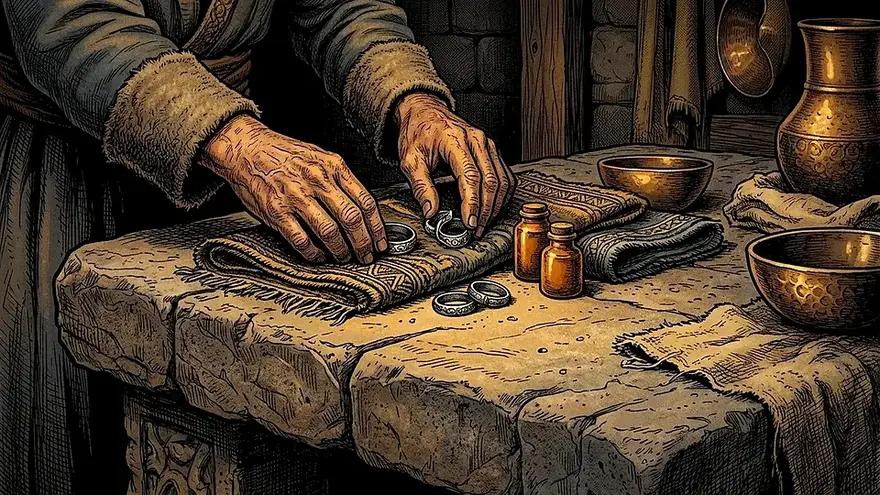
Few passages in human history have been twisted more dishonestly than Genesis 9:25. During the early modern transatlantic slave trade and in nineteenth-century American pro-slavery tracts, apologists preached a 'Curse of Ham,' claiming Noah cursed Black Africans with dark skin and perpetual servitude.
Every piece of that claim falsifies the Hebrew text. First, Ham himself is never cursed—Canaan is. Second, skin color is never mentioned anywhere in Genesis 9. Third, in Genesis 10's Table of Nations, Ham's African lineages (such as Cush/Nubia and Put) are wholly untouched by the oracle, whereas Canaan's descendants were Mediterranean Levantine peoples—Phoenicians, Jebusites, and Amorites—living in modern Lebanon and Israel-Palestine.
Genesis 10:6, 15–19“The sons of Ham: Cush, Egypt (Mizraim), Put, and Canaan... Canaan fathered Sidon his firstborn and Heth, and the Jebusites, the Amorites... and the territory of the Canaanites extended from Sidon... as far as Gaza.”
What Genesis 9 Actually Says vs. The 'Curse of Ham' Myth
Fact-checking four centuries of racialized misquotation against the Hebrew text of Genesis 9–10.
| Question | Distorted 'Curse of Ham' Myth | Hebrew Text of Genesis 9–10 |
|---|---|---|
| Who Was Cursed? | Ham and all his descendants | Strictly Canaan alone (arur Kena'an, Genesis 9:25) |
| Geographic Region | Sub-Saharan Africa | Mediterranean Levant: Sidon to Gaza and Sodom (Genesis 10:15–19) |
| Mention of Skin Color? | Claimed Ham was turned dark-skinned | Zero mention of skin tone anywhere in the Hebrew narrative |
| Historical Fulfillment | Misused to justify modern chattel slavery | Prophetic etiology for Canaan's subjugation to Israel (Shem) & Philistia/empires |
What to Remember
- Genesis 9:18 and 9:22 twice insert the pointer 'Ham was the father of Canaan' so ancient Israelite readers immediately link Ham's boundary-breaking contempt to Canaanite practices condemned in Leviticus 18.
- Whether Ham's offense was brazen filial humiliation or the Levitical idiom 'uncovering his father's nakedness' (sleeping with a father's wife to seize patriarchal rank), Shem and Japheth model protective honor by walking backward.
- The infamous 'Curse of Ham' claiming dark skin was cursed in Genesis 9 has zero basis in Hebrew Scripture: Ham himself was never cursed, and Canaan settled the Levant rather than sub-Saharan Africa.