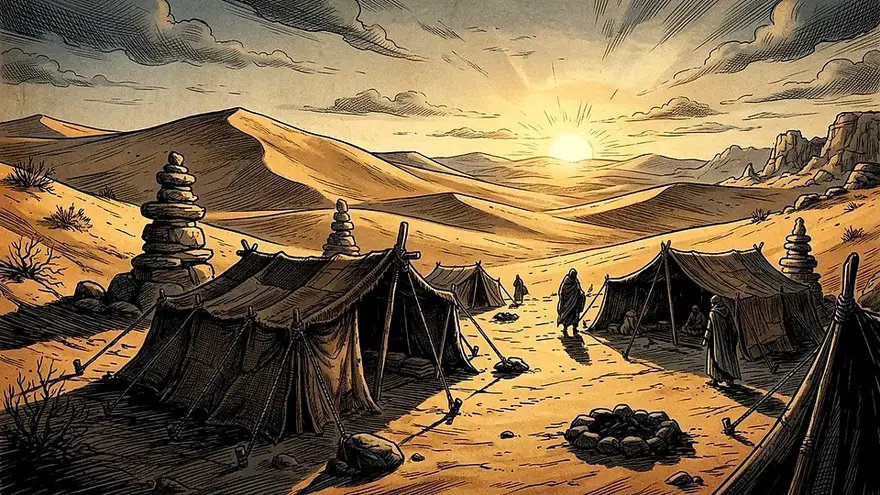
In Exodus 16:15, hungry Israelites step out of their tents at dawn, spot fine frost-like flakes left by receding dew, and ask one another 'Man hu?' (מָן הוּא, 'What is it?')—giving manna its name. Resembling white coriander seed tasting of honey wafers and olive oil, it taught daily trust until ceasing at Gilgal (Joshua 5:12).
Man hu’: The miracle whose name is a question mark
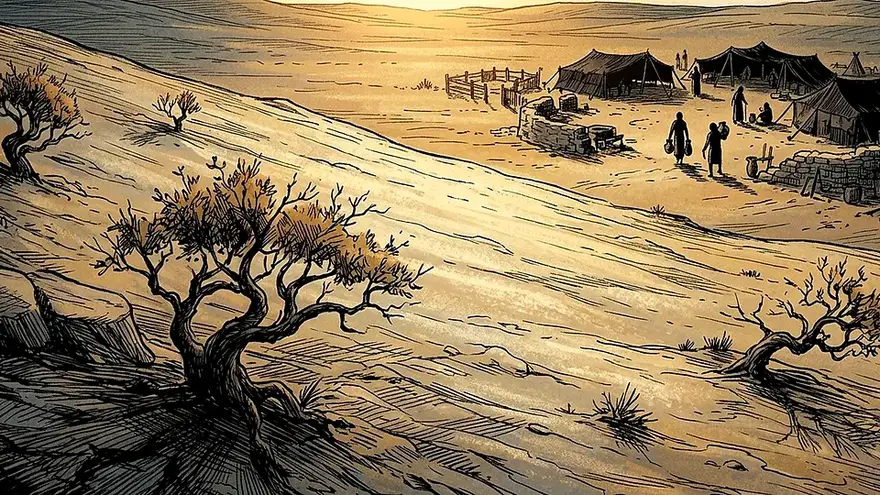
Six weeks after crossing the Red Sea, Israel's flour sacks hit empty in the barren Wilderness of Sin (Exodus 16:1–3). Next morning, a blanket of heavy desert dew evaporates to reveal something delicate and scale-like—Hebrew mechuspas, a rare participle occurring nowhere else in the Bible—glittering like fine hoarfrost across the sand.
In standard Jerusalem Hebrew 'what?' is mah (מָה), yet in Aramaic and older Northwest Semitic dialects spoken among Semitic laborers in Egypt's eastern Delta, man (מָן) meant 'what?' Stepping outside, bewildered families point at the ground and ask Man hu’ (מָן הוּא, 'What is it?')—accidentally coining its name forever.
Exodus 16:14–15“There on the face of the wilderness was a fine, flake-like thing, fine as frost on the ground. When the people of Israel saw it, they said to one another, 'What is it?' (Man hu’) For they did not know what it was.”
Why It Matters: KJV created an accidental riddle ('It is manna, because they didn't know what it was!'), whereas modern Bibles recognize dialectal Semitic man hu' as the astonished question 'What is it?'—already translated 'What is this?' in the 3rd-century BCE Septuagint.
Scrolls & Archaeology: Standard Biblical Hebrew asks 'what?' with mah (used in the second half of the verse), while Northwest Semitic, Aramaic, and Old South Arabic dialects used man—preserving a playful folk-etymological pun inside Exodus 16:15. Botanist Friedrich Bodenheimer's 1927 Sinai expedition confirmed that scale insects (Trabutina mannipara) feeding on desert tamarisk exude sweet white crystalline drops still called mann by Sinai Bedouin, though seasonal summer drops cannot account for Exodus 16's Friday double portion or Sabbath pause.
Coriander seed, bdellium resin, honey wafers, and fresh olive oil
Critics sometimes claim Exodus 16:31 ('tasted like wafers made with honey') contradicts Numbers 11:8 ('tasted like cakes baked with oil'). Read how ancient cooks prepared it and both descriptions click straight into place.
Scooped raw into baskets before the hot desert sun melted it (Exodus 16:21, 31), the small round white granules looked like coriander seed with the pearly, translucent sheen of aromatic bdellium resin (bedolach) and tasted crisp and honey-sweet. Once families ground the grains on basalt hand-mills, pounded them in mortars, and baked flat cakes over campfires (Numbers 11:8), the warm bread took on the rich, savory flavor of olive-oil pastry.
Exodus 16:31 & Numbers 11:7–8“Exod 16:31 — 'It was like coriander seed, white, and the taste of it was like wafers made with honey.' · Num 11:8 — 'The people... ground it in mills or beat it in mortars... and its taste was like the taste of cakes baked with oil.'”
Evaluating the Sinai tamarisk insect theory against Exodus 16
In 1927, entomologist F. S. Bodenheimer documented a real biological curiosity in southern Sinai wadis: during May and June, tiny scale insects (Trabutina mannipara) feed on desert tamarisk branches and excrete pinhead-sized white sugar drops that crystallize overnight, melt in midday heat, and are still harvested by Bedouins under the Arabic name mann es-sama.
While Exodus evokes recognizable Sinai desert imagery, insect honeydew yields only a few seasonal ounces under scattered shrubs. Exodus 16 portrays an unmistakable miracle: daily two-liter portions (’omer) across rocky plains in every season, overnight maggot rot Monday through Thursday, zero rot plus double yield every Friday, and sudden termination the day after Passover inside Canaan (Joshua 5:12).
Joshua 5:12“And the manna ceased the day after they ate of the produce of the land. And there was no longer manna for the people of Israel.”
Why God forbade hoarding—from Deuteronomy 8 to John 6
Why didn't God drop forty-year silos of grain at Sinai so nobody had to kneel every dawn? Deuteronomy 8:3 spells out the spiritual training: God let Israel feel daily dependence 'that He might make you know that man does not live by bread alone, but by every word from the mouth of the LORD,' sealing one memorial ’omer jar beside the Ark (Exodus 16:33).
Centuries later around Passover in John 6:31–35, Galilean crowds quote Psalm 78:24 ('He gave them bread from heaven') to demand a new political Moses. Jesus answers quietly that everyone who ate Exodus manna still died—offering Himself as the imperishable Bread of Life.
Deuteronomy 8:3 & John 6:35“Deut 8:3 — 'He humbled you and let you hunger and fed you with manna... that he might make you know that man does not live by bread alone.' · John 6:35 — 'Jesus said to them, "I am the bread of life."'”
Sinai Tamarisk Honeydew vs. Biblical Manna (Exodus 16)
Comparing natural Sinai desert secretions documented by botanists with the Torah's account.
| Trait | Sinai Tamarisk Secretion | Exodus 16 / Joshua 5 Account |
|---|---|---|
| Appearance & Sun Behavior | White sugar pearls excreted on twigs; ants clear or sun melts by mid-morning | Fine frost-like coriander granules on ground; melted when sun grew hot (Exod 16:21) |
| Season & Volume | 3–6 weeks in May–June; tiny harvest limited to wooded tamarisk wadis | Year-round for 40 years across barren camps; one ~2-liter ’omer per person daily |
| Weekly Rhythm | Falls identically seven days a week during insect season | Spoils overnight Days 1–5, yields double on Friday, absent every Sabbath (Exod 16:22–26) |
| How It Ended | Fades gradually whenever summer drought or rainfall shifts | Stopped abruptly the exact day after Israel ate Canaan's harvest at Gilgal (Josh 5:12) |
What to Remember
- Hebrew man hu’ (מָן הוּא) uses an archaic Semitic question word ('What is it?'), preserving the puzzled reaction of newly freed slaves on morning one.
- Sinai tamarisk scale insects excrete sweet white droplets in early summer, yet Exodus 16's Sabbath cessation, Friday double yield, and 40-year span transcend seasonal sap.
- Deuteronomy 8:3 and John 6:31–35 reveal manna's deeper purpose: weaning anxious people from hoarding toward daily reliance on God's living word.