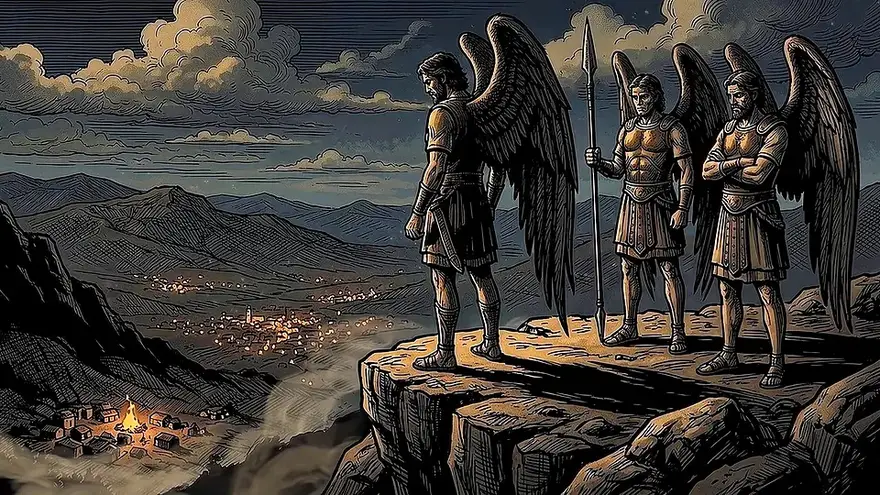

Enoch, the seventh patriarch from Adam in Genesis 5:21–24, shatters the chapter's relentless 'and he died' refrain at age 365. Twice the Hebrew says Enoch 'walked closely with God' (wayyithallekh Chanoch ’et-ha-’Elohim), concluding 'and he was no more, because God took him' (laqach)—the exact verb used when God sweeps Elijah heavenward in 2 Kings 2.
Breaking the graveyard drumbeat at generation seven
Read Genesis 5 aloud in Hebrew and it tolls like an iron bell over a cemetery: Adam lived... wayyamot ('and he died'); Seth lived... wayyamot; Enosh, Kenan, Mahalalel, Jared... wayyamot. Mortality reigns unchallenged over every generation outside Eden.
Then arrives generation seven—the sacred sabbath slot in Hebrew genealogy, contrasting directly with Cain's seventh descendant, boastful killer Lamech (Genesis 4:19–24). Instead of saying Enoch merely 'lived' after fathering Methuselah, Genesis switches twice to the reflexive verb wayyithallekh ’et-ha-’Elohim ('walked back and forth with God'), echoing God's evening walks in Eden (Genesis 3:8).
Genesis 5:22, 24“Enoch walked with God after he fathered Methuselah 300 years... Enoch walked with God, and he was not, for God took him.”
Why It Matters: Hebrews 11:5 ('he was commended as having pleased God') quotes the 3rd-century BCE Greek Septuagint rendering of Genesis 5:24 rather than the literal Hebrew idiom 'walked with God.'
Scrolls & Archaeology: Hebrew laqach ('took') in Genesis 5:24 matches both 2 Kings 2:3–10 (when YHWH sweeps Elijah up in a whirlwind) and Akkadian cognate leqû in Tablet XI.205 of the Standard Babylonian Epic of Gilgamesh, where flood-hero Utnapishtim recounts 'they took me (ilqûinnima) and settled me afar at the mouth of the rivers.' Enoch's lifespan of 365 years mirrors the 365-day solar calendar championed against lunar reckoning inside 1 Enoch's Astronomical Book (4Q208–4Q211, 3rd century BCE).
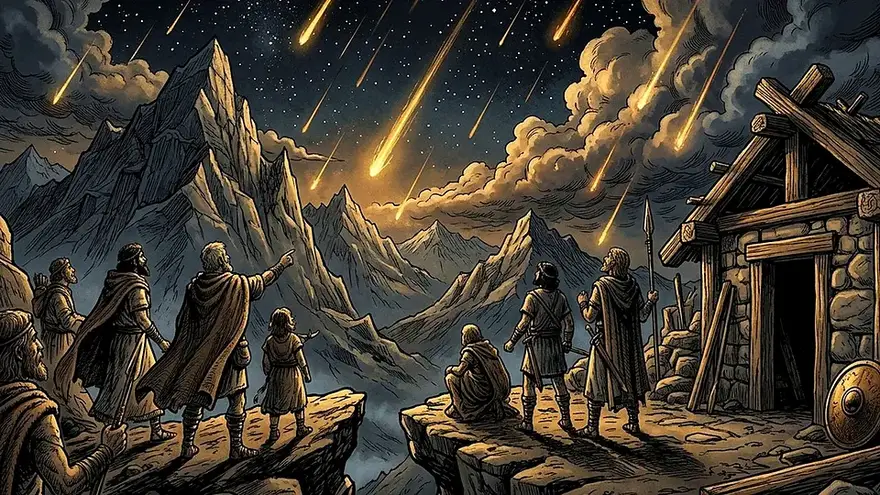
Four cryptic Hebrew words: 'He was not, for God took him'
Genesis 5:24 closes Enoch's biography in four hushed Hebrew words: wĕ-’einennu ki-laqach ’oto ’Elohim ('and he was no more, because God took him'). In classical Hebrew narrative, ’einennu describes someone who suddenly vanishes from where onlookers expect to find him (1 Kings 20:40).
Even more telling is the verb laqach (לָקַח, 'took'). Across the entire Old Testament, only one other human departure receives that wording: Elijah's whirlwind ascent in 2 Kings 2:3–10, when prophets ask Elisha, 'Do you know that today the LORD is taking (loqeach) your master?' and Psalm 49:15 echoes, 'God will ransom my soul from Sheol, for He will take me.'
2 Kings 2:3 & Psalm 49:15“2 Kgs 2:3 — 'Know that today the LORD will take away your master.' · Ps 49:15 — 'God will ransom my soul from the power of Sheol, for he will receive (yiqqacheni) me.'”
Mesopotamia's seventh sage and Qumran's Aramaic Enoch scrolls
Why did Enoch live exactly 365 years? In ancient Mesopotamian lore, the seventh pre-Flood ruler was Enmeduranki of Sippar—cult center of the sun-god Shamash—who was welcomed into the divine assembly and shown heavenly calendar secrets. Genesis quietly reclaims that solar prestige for a man who walked solely with Israel's Creator.
During the Second Temple centuries before Jesus, Jewish scribes expanded Genesis 5:24 into the sprawling apocalyptic anthology 1 Enoch. Archaeologists recovered eleven Aramaic Enoch manuscripts in Qumran's Cave 4 (4Q201–4Q212), and Jude 14–15 quotes 1 Enoch 1:9 directly while calling him 'Enoch, the seventh from Adam.'
Jude 14–15“It was also about these that Enoch, the seventh from Adam, prophesied, saying, 'Behold, the Lord came with ten thousands of his holy ones.'”

How the Greek Septuagint and Hebrews 11:5 read Enoch's exit
When Jewish scholars in third-century BCE Alexandria translated Genesis 5:24 into Greek, they interpreted 'walked with God' as 'he pleased God' (euērestēsen tō Theō) and rendered God 'took' him as 'God transferred/translated him' (metethēken, μετέθηκεν), adding 'he was not found.'
Three centuries later, the author of Hebrews 11:5 builds straight atop that Septuagint phrasing to strip away occult speculation and spotlight everyday trust. Enoch wasn't spared death's grip because he mastered esoteric star charts, says Hebrews, 'for before he was taken he was commended as having pleased God—and without faith it is impossible to please Him.'
Hebrews 11:5“By faith Enoch was taken up so that he should not see death, and he was not found, because God had taken him.”
Enoch Across Genesis, Dead Sea Scrolls & the New Testament
How a four-verse Hebrew enigma grew across ancient texts while retaining its core theme.
| Source Text | Date | Key Phrase / Portrait | Distinctive Emphasis |
|---|---|---|---|
| Genesis 5:21–24 (MT) | Torah | Wayyithallekh ’et-ha-’Elohim... laqach | Intimate daily fellowship breaking the 'and he died' refrain at 365 |
| Greek Septuagint (LXX) | 3rd c. BCE | Euērestēsen ('pleased God') / metethēken | Clarifies 'he was not' as 'he was not found' because God transferred him |
| 1 Enoch (Qumran 4Q201–212) | 3rd–1st c. BCE | Heavenly scribe of solar calendar & Watchers | Cosmic visionary tours preserved in Aramaic at Qumran and canonized in Ethiopia |
| Hebrews 11:5 & Jude 14 | 1st c. CE | 'By faith Enoch was taken... seventh from Adam' | Celebrates trusting relationship with God and cites his prophetic voice |
What to Remember
- Positioned seventh from Adam in Seth's line, righteous Enoch stands as the direct foil to Cain's seventh-generation descendant, violent Lamech.
- Genesis 5:24's verb laqach ('took') matches 2 Kings 2:3–10, making Enoch and Elijah the only two figures in the Hebrew Bible carried away without dying.
- Genesis's 43-word riddle inspired eleven Aramaic Dead Sea Scrolls (1 Enoch), quoted in Jude 14–15, alongside Hebrews 11:5's portrait of quiet faith.